Here’s What We Cover
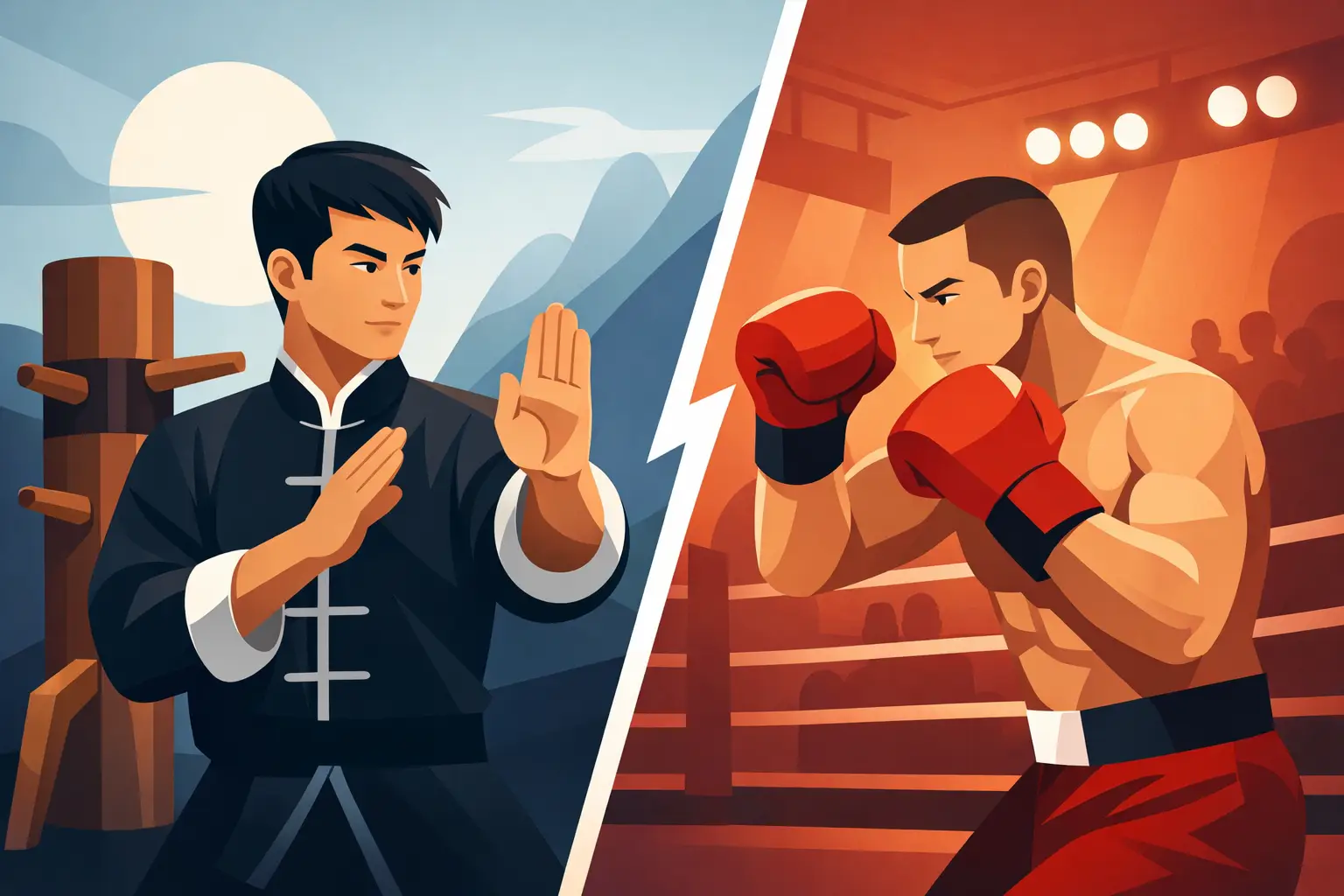
A raised guard, quick footwork and powerful punches make boxing look immediately familiar. Wing Chun can look very different: hands held forward, short strikes, close contact and a focus on controlling the centre. When people ask about Wing Chun versus boxing, they usually want one clear answer: which one works? The honest answer is that both can be highly effective, but they train different responses, at different ranges, for different goals.
For teenagers and adults considering martial arts in Norwich, the better question is not which style wins an imaginary contest. It is which training will help you become fitter, calmer, more confident and better prepared to protect yourself if a situation cannot be avoided.
Wing Chun versus boxing: the main difference
Boxing is a combat sport built around efficient punching, movement, timing and conditioning. A boxer learns to use the jab, cross, hooks and uppercuts while defending with footwork, head movement, blocks and a tight guard. Regular sparring is central to the sport, so students become accustomed to dealing with pressure from a resisting partner.
Wing Chun is a close-range Chinese martial art. Its best-known ideas include protecting the centreline, attacking and defending at the same time, using direct strikes and maintaining contact with an opponent’s arms. Rather than trading wide punches from the outside, Wing Chun often aims to close the gap, disrupt an attacker’s balance and create a fast route to safety.
Neither approach is magic. Boxing does not teach every self-defence answer, and traditional Wing Chun practice without pressure testing can leave gaps. The quality of coaching, the consistency of training and the willingness to practise against realistic resistance matter more than a style name on the door.
What boxing does exceptionally well
Boxing develops sharp, reliable punching mechanics. Students learn how to generate force through their legs and hips, how to hit while moving, and how to avoid standing still in front of someone who is throwing punches. It is hard physical work, and that is one of its greatest strengths.
A good boxing gym also teaches composure under pressure. Sparring, when coached safely and sensibly, helps people deal with distance, speed, fatigue and the shock of an opponent fighting back. That experience is valuable. Many people can perform a technique on pads but struggle when another person is moving unpredictably.
The fitness benefits are substantial too. Boxing can improve cardiovascular fitness, coordination, stamina and mental toughness. If your main aim is to compete, enjoy the challenge of rounds and test your striking in a sporting environment, boxing is an excellent choice.
There are trade-offs. Boxing rules restrict what students train. There are no kicks, grabs, clinch breaks, eye-line awareness, weapon considerations or escape-focused scenarios in a standard boxing match. It is designed to create skilled boxers, not to cover every problem that might arise outside the ring.
Where Wing Chun can be useful
Wing Chun is particularly relevant when there is little room to move. An argument in a hallway, near a doorway, beside a car or in a crowded venue does not look like a boxing ring. You may not have the space to circle away or throw a long combination.
The system’s close-range emphasis can help students understand positioning when arms collide, punches become messy and personal space disappears. Straight strikes, palm strikes, elbows, low kicks and controlling the centre can all be practical tools when used with good judgement.
Wing Chun also encourages efficiency. A smaller person should not rely on being stronger than an aggressor. Good technique, balance, timing and awareness give a student better options than trying to overpower someone. That makes the art appealing to beginners, mature students and anyone who does not see themselves as naturally athletic.
However, Wing Chun needs to be taught realistically. Drilling set movements is useful for building coordination, but it is not enough on its own. Students also need controlled pressure, movement, realistic reactions and an understanding that a determined attacker will not feed the same response twice. Effective self-defence training must be honest about chaos, adrenaline and the need to get away safely.
Range changes the answer
At longer range, a trained boxer has obvious advantages. Their footwork, punching accuracy and ability to manage distance are developed through repeated practice against live opponents. If someone is throwing committed punches from the outside, boxing teaches proven ways to defend and respond.
At very close range, Wing Chun principles can become more useful. A tight guard, forward structure and awareness of arm contact can help when there is no clean space for big punches. The goal should not be to stay there and exchange blows. It should be to create an opening, protect yourself and leave.
This is why a practical martial artist should avoid rigid thinking. Saying that one style always beats another misses the point. Distance, surroundings, fitness, experience, surprise and the number of people involved all change the situation. In real life, avoiding trouble early remains the best self-defence skill.
Technique is only part of the picture
A person’s ability is not decided by their favourite style. A well-trained boxer is a serious opponent. So is a Wing Chun student who has trained consistently, learned to handle resistance and understands when not to engage.
The reverse is also true. Someone who has collected techniques but never tested their balance, timing or reactions may struggle when pressure rises. Good training should make you more capable without giving you false confidence.
Should you choose boxing or Wing Chun?
Choose boxing if you want a focused striking sport, high-energy fitness and the option to compete. It is direct, demanding and effective at developing punch defence, movement and confidence under sporting pressure.
Choose Wing Chun if you are drawn to close-range self-defence, practical body mechanics and an approach that does not depend on size or acrobatic ability. Look for classes that teach the traditional foundations while adapting training to the way confrontations actually unfold.
For many people, the strongest answer is not an either-or choice. Boxing can sharpen your movement and punching, while Wing Chun can add close-range tools and a different way of thinking about contact. Cross-training has value when it is guided well and when students understand the purpose behind each drill.
At Fusion Kung Fu, Shiyong Kung Fu uses Wing Chun foundations alongside useful elements from other martial arts. The aim is not to preserve techniques simply because they are traditional. It is to help students build practical skills, discipline, fitness and confidence in a structured, supportive environment.
What beginners should look for in a class
The right club should feel welcoming, but it should not pretend that martial arts are effortless. You should expect clear instruction, a sensible progression for beginners and training partners who help you improve rather than try to prove something.
Ask how the class develops real reactions. Are students learning footwork and distance as well as individual techniques? Is there controlled partner work? Are safety, respect and good judgement treated as part of self-defence, rather than an afterthought?
Parents of teenagers should also look beyond the style itself. Consistent martial arts training can give young people a healthier outlet for stress, better posture, improved focus and a stronger sense of personal boundaries. Anti-bullying awareness is not about teaching a child to fight at school. It is about helping them recognise risk, speak with confidence, seek support and avoid being an easy target.
The real test is consistency
The debate around Wing Chun and boxing can become overly technical, but the biggest difference in your progress is usually much simpler: will you keep turning up? The class you enjoy, understand and can attend regularly will do more for your confidence than the style you only research online.
A good first session should leave you challenged, safe and keen to return. Start there, train with patience and let your ability be built through practice rather than promises.
About the Author: Keith Ratcliffe
