Here’s What We Cover
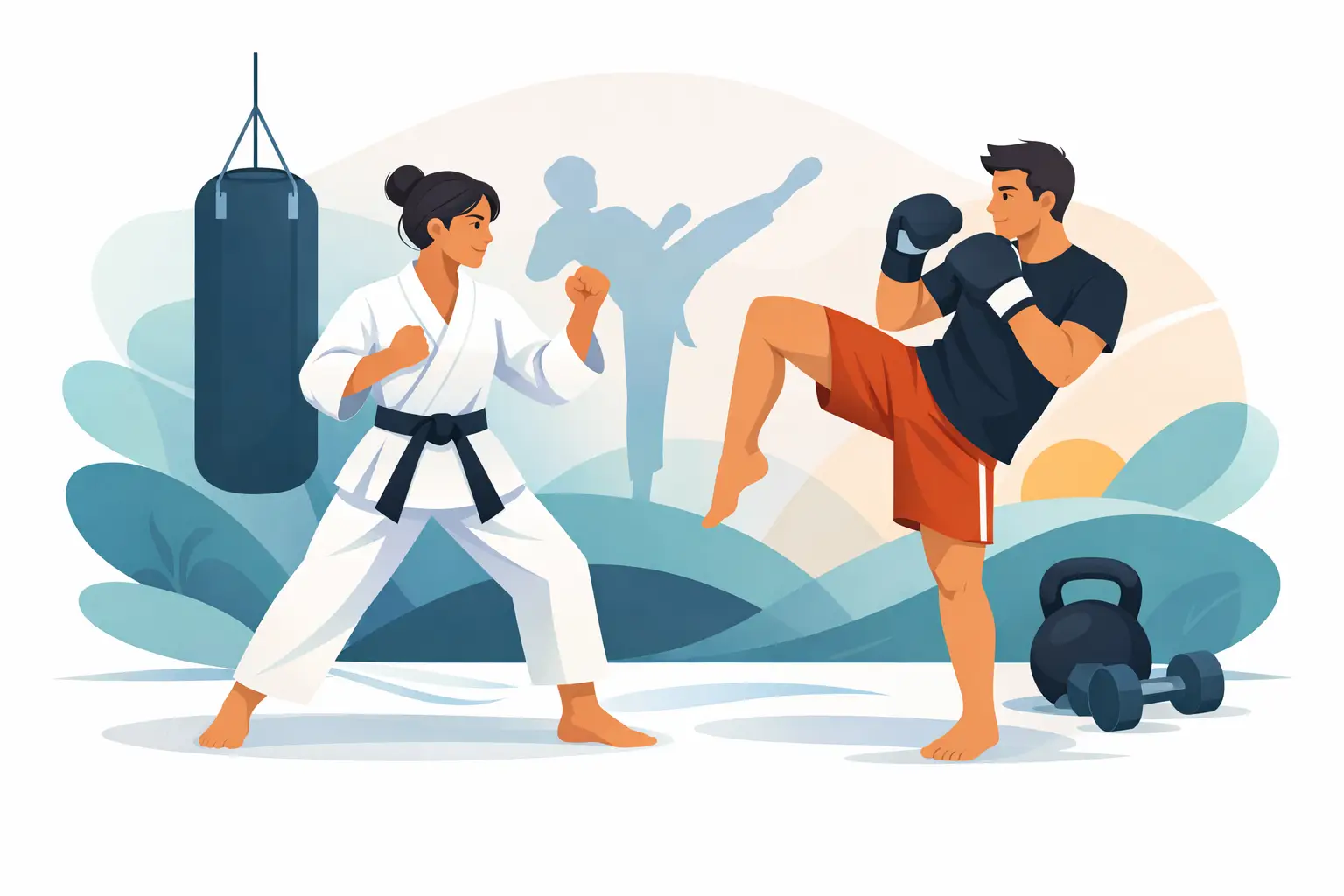
If the gym has never quite held your attention, you are not the only one. Plenty of people want to get fitter, stronger and more confident, but the usual routine of treadmills, machines and counting reps feels repetitive after a week or two. That is exactly why martial arts for fitness beginners makes sense. It gives you a reason to train, a structure to follow and skills that feel useful beyond the class itself.
For many beginners, the biggest surprise is that martial arts training does not begin with flying kicks or anything flashy. Good training starts with posture, balance, movement, coordination and controlled technique. You improve your fitness because you are working with purpose, not because someone told you to do another ten minutes on a bike.
Why martial arts works so well for fitness beginners
A lot of fitness plans fail because they rely on motivation alone. Martial arts gives you something better than motivation – progress you can feel. One week you are learning how to move properly. A few weeks later, your stance feels more stable, your reactions are sharper and you are no longer out of breath as quickly.
That matters for beginners because fitness is easier to stick with when it feels practical. Martial arts training combines cardio, strength, mobility and mental focus in one session. You are not just exercising for the sake of it. You are learning how to control your body, improve your timing and stay calm under pressure.
There is also a strong confidence benefit. Many adults and teenagers start because they want to get fitter, but stay because they feel more capable. Parents often see the same pattern in younger students as well. Better posture, better focus and a clear sense of achievement tend to carry over into daily life.
What beginners usually worry about
Most people thinking about their first class have the same concerns. Am I fit enough? Am I too old? Will everyone else be ahead of me? Do I need to be flexible? The honest answer is that a good beginner class is built for people who are starting from scratch.
You do not need to be naturally athletic to begin. In fact, many people join because they are not currently fit and want a better way to change that. Martial arts training should meet you where you are. If an instructor expects complete beginners to perform like experienced students, that is a problem with the coaching, not with the student.
It is also worth saying that martial arts is not one thing. Some styles lean heavily towards sport, some towards tradition and some towards practical self-defence. If your main goal is fitness, the best choice is usually a class that offers structured coaching, realistic training and a pace that lets you build properly. That tends to be far more sustainable than environments built around competition or performance.
Martial arts for fitness beginners: what to expect in class
Your first few sessions should feel challenging but manageable. You will likely spend time on warm-ups, footwork, basic striking mechanics, simple partner drills and conditioning. None of that needs to be theatrical to be effective. In fact, straightforward training is often what gets the best results.
Expect to use your whole body. Even basic drills raise your heart rate, work your legs and core, and improve coordination. You are learning to move efficiently, which is very different from simply throwing effort around. That is one reason martial arts can suit beginners better than random high-intensity workouts. Technique helps you work smarter as well as harder.
You should also expect structure. A well-run class has a clear progression. You learn one piece, repeat it, improve it and then build on it. That sense of order is especially helpful if you have found other fitness settings intimidating or directionless.
The fitness benefits are broader than people expect
When most people think about getting fit, they think about weight loss or cardio. Martial arts can help with both, but the benefits are wider than that.
You will usually notice stamina improving first. Classes keep you moving in short bursts with enough repetition to build endurance over time. Then strength starts to improve, especially through body control, stance work and striking practice. You may also feel your mobility getting better because training asks your joints and muscles to move with more control.
Then there are the benefits people do not always put on a fitness checklist. Better concentration. Better stress management. More discipline with routine. These matter because long-term fitness is not just physical. It depends on consistency, and consistency is easier when training helps your head as much as your body.
Choosing the right class matters
Not every martial arts club is right for every beginner. That is not a criticism, just reality. The key is finding training that matches your goals.
If you want a practical route into fitness and self-defence, look for a club that teaches clearly, welcomes beginners and focuses on techniques that work in real situations. You should be able to ask questions without feeling awkward. You should feel coached, not thrown in at the deep end.
It also helps to look at the class culture. Serious training does not need to be hostile. The best clubs are disciplined and supportive at the same time. Beginners improve faster in environments where standards are high but instruction is encouraging.
For anyone in Norwich looking for that balance, Fusion Kung Fu offers structured training designed to be accessible from day one, with a clear focus on practical skill, steady fitness gains and real-world confidence.
Why practical martial arts often suits beginners best
For fitness beginners, practical systems often have an advantage. They strip away a lot of the unnecessary clutter and focus on movement, timing, awareness and control. That keeps training grounded and makes progress easier to understand.
A practical style such as Shiyong Kung Fu, with close-range concepts and direct application, can be particularly useful for people who want fitness with purpose. You are not spending months chasing complicated routines that may never feel relevant. You are learning efficient movement and effective technique while improving your conditioning week by week.
That said, the right fit still depends on the individual. Some people enjoy a more traditional setting. Others want a modern, no-nonsense approach. The important thing is to be honest about why you are starting. If your goal is to become fitter, stronger and more capable in everyday life, practical training usually ticks more boxes.
How to make your first month a success
The first month is not about proving anything. It is about building the habit. Turning up regularly matters more than trying to win every drill or push beyond your limits in week one.
Give yourself permission to be new. Some techniques will feel awkward at first. Your coordination may need time to catch up with what your brain understands. That is normal. Improvement in martial arts is earned through repetition, not talent alone.
It also helps to measure progress properly. Do not focus only on weight or appearance. Pay attention to how your energy changes, how quickly you recover between drills, how much sharper your movement feels and how your confidence grows. Those are real signs that the training is working.
Outside class, keep things simple. Get enough rest, drink enough water and avoid the common beginner mistake of doing too much too soon. Soreness is normal. Exhausting yourself for the sake of it is not. Consistency beats intensity when you are starting out.
Is martial arts better than the gym for beginners?
Sometimes yes, sometimes no. It depends on the person.
If you like total freedom, enjoy training alone and already know how to structure your workouts, the gym may suit you well. But if you struggle with boredom, lack confidence or want coaching and accountability, martial arts often works better. You are not left to make up a programme on your own. You arrive, train with purpose and leave knowing what you have improved.
There is also the question of staying engaged. A lot of beginners stop exercising because it feels disconnected from real life. Martial arts solves that problem by teaching useful skills while building fitness. For many people, that is the difference between giving up and sticking with it.
Starting martial arts does not require you to be fit first. It is one of the ways you become fit in the first place. If you choose a club with the right coaching, the right atmosphere and a practical approach, you can build stamina, strength and confidence at the same time. The hardest part is usually not the training itself – it is deciding to walk through the door for the first session.
About the Author: Keith Ratcliffe
