Here’s What We Cover
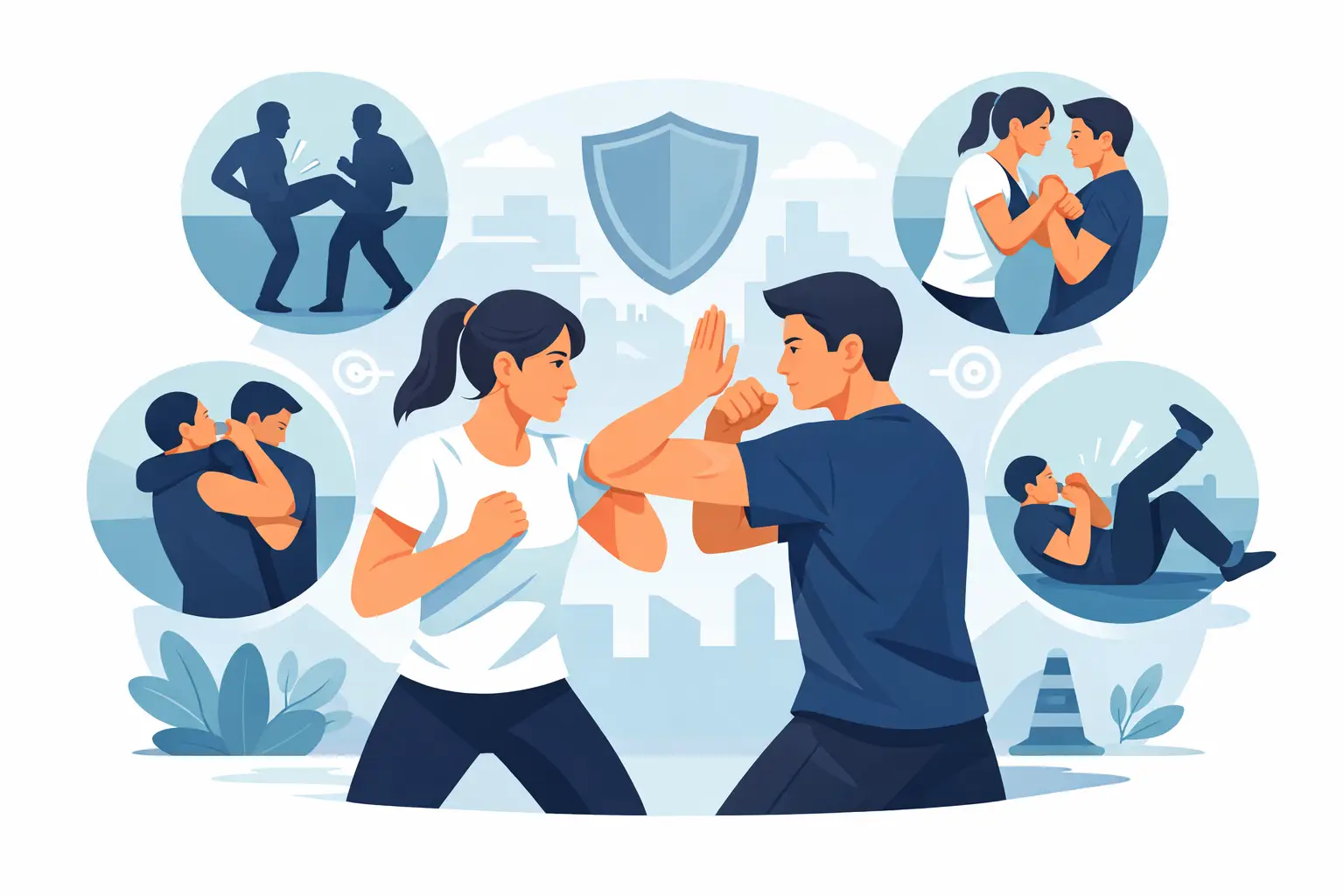
Most people do not start looking at self defence because they want to fight. They start because they want to feel less vulnerable walking home, more confident setting boundaries, or better prepared if a situation turns ugly fast. That is why self defence techniques for beginners should start with simple, practical skills you can actually remember under pressure, not flashy moves that fall apart in real life.
For beginners, the biggest mistake is thinking self defence begins with striking. It does not. Effective self defence starts earlier, with awareness, positioning, clear communication and a few reliable physical responses that work when adrenaline kicks in. You do not need to be naturally strong, flexible or experienced to begin. You need the right habits, proper coaching and enough repetition to make your reactions cleaner and calmer.
What beginners really need from self defence
A good beginner approach should do three things. It should help you avoid trouble where possible, give you straightforward answers when avoidance fails, and build confidence without creating false confidence. That last point matters. There is a difference between feeling capable and assuming you can handle every situation alone.
Real self defence is not about winning exchanges or looking impressive. It is about creating an opportunity to get safe. Sometimes that means using your voice. Sometimes it means breaking contact and leaving. Sometimes it means striking hard and fast to stop someone long enough to escape. It depends on the situation, the space around you, the number of people involved and whether there is a clear exit.
Self defence techniques for beginners that actually make sense
1. Awareness and positioning
This is the skill that prevents more problems than any punch or kick ever will. Awareness means noticing what is happening around you early enough to make better choices. Positioning means placing yourself where you are harder to corner, grab or overwhelm.
For beginners, that can be as simple as keeping a little distance when someone is behaving aggressively, not letting an unknown person close the gap without reason, and being aware of exits in public spaces. If something feels off, create space sooner rather than later. Many people ignore their instincts because they do not want to seem rude. In self defence, polite hesitation can cost you time.
2. Fence hands and ready posture
One of the most useful self defence techniques for beginners does not look dramatic at all. A non-threatening guard position, often called a fence, puts your hands up between you and the other person while still looking like you are trying to calm things down.
This matters because it does two jobs at once. It helps you manage distance and gives you a better starting position if you need to protect yourself quickly. Hands low and body square can leave you exposed. Hands up, chin protected and weight balanced give you a far better chance of reacting. It is simple, but simplicity is exactly what beginners need.
3. Verbal boundaries
Your voice is part of self defence. A clear, firm command such as “Back off” or “Stay there” can interrupt someone’s momentum, draw attention from others and help you take control of your own mindset.
The key is clarity, not shouting for the sake of it. Nervous laughter, apologising and mixed signals often encourage an aggressive person to keep pushing. A direct verbal boundary is not guaranteed to stop someone, but it often buys a second or two. In a real incident, that can be enough to change what happens next.
4. Escaping wrist grabs and basic holds
Beginners often worry about elaborate attack scenarios, but common problems are much more basic. Someone grabs your wrist. Someone blocks your path. Someone reaches in close and tries to control you. Before learning complex combinations, it makes sense to learn how to break simple grips and move away.
Good grip escapes rely more on timing, angle and body movement than raw strength. That is encouraging for teenagers, adults and anyone who does not see themselves as physically powerful. The point is not to stand there and wrestle. The point is to release the hold, disrupt balance if needed, and get out.
5. Palm strikes and straight-line striking
If a physical response becomes necessary, beginners are usually better off learning palm strikes before fancy punches. A palm strike is direct, natural and less likely to damage your hand than hitting with a bare fist. In close range, where many real confrontations happen, simple straight-line strikes can be fast and effective.
Targets matter here. In training, beginners should learn safe control and responsible practice, but they also need to understand that self defence is about stopping immediate danger. Precision is more useful than wild power. One clean, committed strike delivered at the right moment is worth far more than a flurry with no structure.
6. Low kicks, knees and close-range tools
High kicks look impressive and fail a lot under pressure, especially for beginners. Balance changes under stress. Clothing restricts movement. Surfaces are uneven. If your goal is practical self-protection, lower-line options usually make more sense.
A low kick to disrupt balance, a knee from close range, or a short-range strike when someone crowds your space can be far more realistic than techniques built for demonstrations. The trade-off is that these tools still require training to apply properly. They are simple, not magical. Without drilling, even the best technique can disappear when you need it.
7. Breaking contact and leaving decisively
This is the finish, not the afterthought. Once you have created an opening, go. Do not stay to argue, prove a point or see if the other person has had enough. The goal is safety.
That sounds obvious, but beginners often picture self defence as a back-and-forth exchange. It should not be. If your action has given you space, use it immediately. Move towards people, light, staff, transport or any place where help is available. Self defence is not about standing your ground for pride. It is about getting home safely.
Why training matters more than memorising moves
Reading about technique helps, but self defence is physical and emotional. Under stress, your fine motor control drops, your breathing changes and your judgement can narrow. That is why proper training matters. You are not just learning what to do. You are learning how to do it when pressure shows up.
A structured class gives beginners something videos cannot. You get coaching on timing, posture, distance, balance and decision-making. You also learn how it feels when another person is moving unpredictably. That experience matters because real self defence is messy. Perfect scenarios do not exist.
This is also where style and teaching approach make a difference. Some training is built around sport rules. Some leans heavily into tradition. Neither is automatically wrong, but beginners looking for practical self-protection usually benefit most from systems that focus on close-range efficiency, pressure-tested basics and realistic responses that do not depend on size or athleticism.
Common mistakes beginners should avoid
The biggest one is overcomplicating things. If a technique takes too long to learn, too much flexibility, or too many steps to remember, it is probably not the best place to start. Beginners need repeatable fundamentals they can build on.
Another mistake is assuming confidence equals readiness. Confidence should come from practice, not wishful thinking. There is also a tendency to focus only on the physical side and ignore avoidance, awareness and de-escalation. That creates gaps.
Parents should watch for this as well. For teenagers especially, good self defence training should build judgement and self-control alongside physical skill. The aim is not to make someone aggressive. It is to help them stay calm, recognise risk and act decisively if they have no other option.
What a good beginner class should feel like
A proper beginner class should be challenging, but not chaotic. You should feel supported, corrected and gradually pushed forward. Techniques should be explained in plain English. There should be structure, repetition and a clear reason behind what you are learning.
You should also leave feeling that the training is realistic rather than theatrical. Practical martial arts are not about collecting moves. They are about building habits that hold up under pressure. At Fusion Kung Fu, that means training methods shaped around what works in modern situations, not performance for its own sake.
For many people in Norwich and the surrounding area, the hardest part is simply starting. They worry they are too old, too unfit, too nervous or too inexperienced. In reality, beginners are exactly who good coaching is for. You do not need to arrive confident. You build that through training.
The best self defence techniques are the ones you can perform when your heart is racing and your options are limited. Start with awareness, solid posture, clear boundaries and a few dependable close-range responses, then train them properly until they become natural. That is how beginners stop feeling helpless and start becoming prepared.
About the Author: Keith Ratcliffe
