Here’s What We Cover
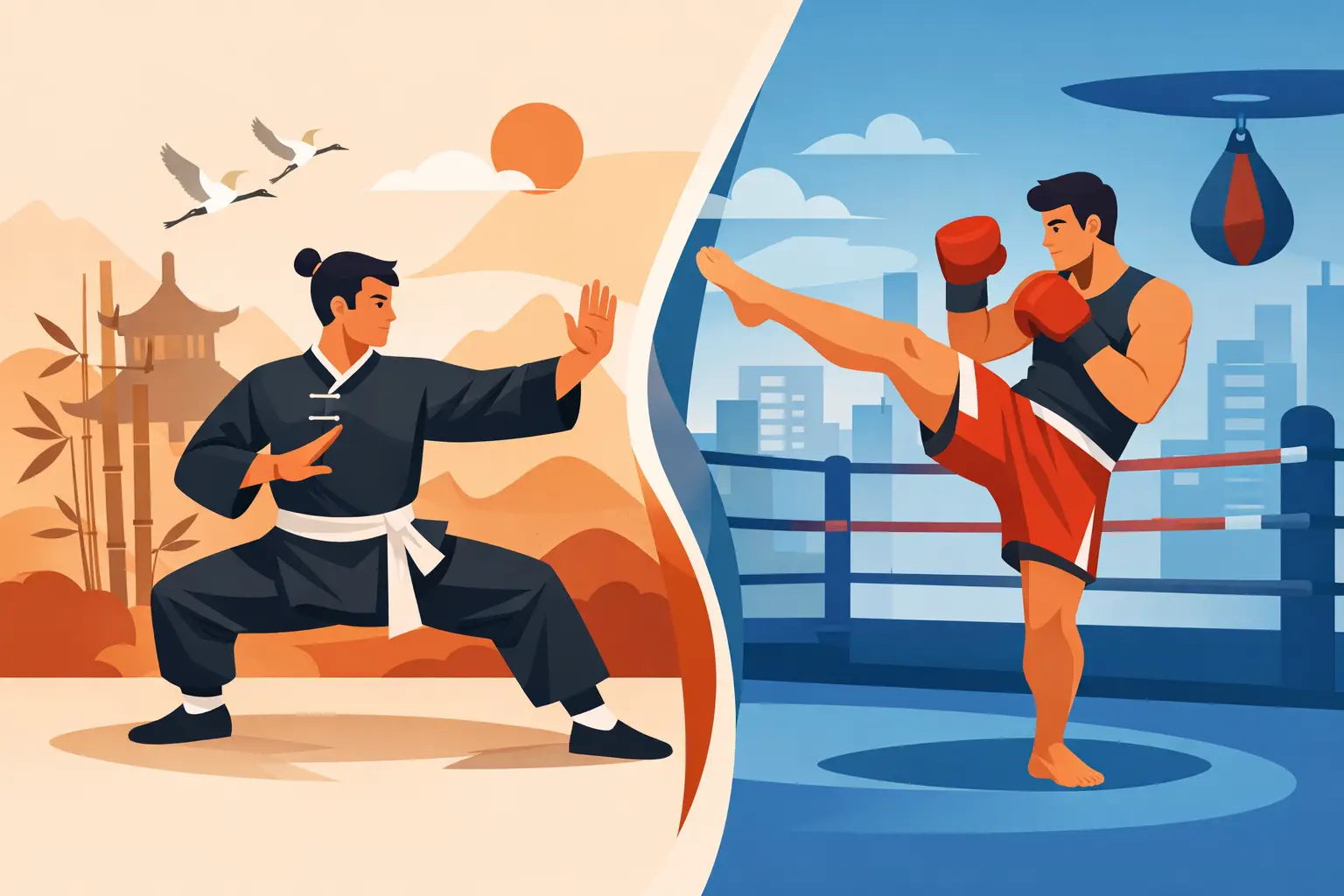
Most people asking about kung fu or kickboxing are not trying to win a debate online. They want to know what will actually help them get fitter, feel more confident and learn skills they can use under pressure. That is the right question to ask, because the best martial art is not the one with the loudest reputation. It is the one that matches your goals, your temperament and the way you want to train.
If you are choosing between the two, the simplest answer is this: kickboxing is usually more sport-focused and conditioning-heavy, while kung fu can vary widely depending on the school and system. That matters. Some kung fu clubs lean towards forms and tradition. Others, such as practical close-range systems, are built around efficiency, timing, structure and real-world self-defence.
Kung fu or kickboxing for real-world goals
On the surface, both can improve fitness, coordination and confidence. Both teach striking. Both can challenge you physically and mentally. The difference is in how they train, what they prioritise and how quickly that training connects to everyday self-defence.
Kickboxing tends to be straightforward to understand. You learn punches, kicks, footwork, pad work and often sparring. Sessions are usually energetic, sweaty and fast-paced. If your main goal is getting fit while learning to strike with power, kickboxing has obvious appeal.
Kung fu is broader. That can be a strength or a weakness depending on the school. Good practical kung fu teaches economy of movement, close-range striking, reactions, positioning and control under pressure. It often places more attention on balance, body mechanics and dealing with situations where there is little space and no neat sporting distance. For many adults and teenagers, that is closer to how real confrontation unfolds.
What kickboxing does well
Kickboxing has earned its popularity for a reason. It is direct, demanding and easy for beginners to grasp. You hit pads, work combinations and build stamina quickly. For people who enjoy high-energy training and like measurable progress, it can be very motivating.
There is also a mental benefit to that kind of training. Repetition builds confidence. Hard rounds teach resilience. You feel yourself getting sharper and stronger, which is often exactly what people need when they first walk into a martial arts class.
For fitness alone, kickboxing is often an excellent choice. The pace keeps your heart rate high, and the training can improve endurance, mobility and general athleticism. If someone wants a workout that feels intense from day one, kickboxing will usually deliver.
The trade-off is that sport habits do not always transfer neatly into self-defence. Gloves, space, rules and expected attacks shape the training. That does not make it ineffective. It just means context matters. A method designed for a ring is not automatically designed for a crowded corridor, a surprise grab or a close-range confrontation.
What practical kung fu does differently
This is where the question of kung fu or kickboxing becomes more specific. Not all kung fu is the same. Some systems are highly traditional, with a strong emphasis on forms, ritual and preserving old methods. For some people that is part of the appeal. For others, it creates distance from the practical reason they started training in the first place.
A modern, usable kung fu system takes a different route. It strips away what is unnecessary and focuses on timing, structure, efficiency and realistic application. Instead of relying on size, flexibility or flashy movement, it teaches students to work intelligently. That makes it especially suitable for beginners, smaller students and adults who want something practical rather than performance-based.
Close-range training is one of the biggest advantages. Real incidents are often messy, sudden and cramped. You may not have room to throw a full kick. You may not get warning. A practical kung fu approach prepares you to deal with pressure at the distance where many confrontations actually happen.
That does not mean training is easier. It means the emphasis is different. Rather than chasing power alone, the focus is on positioning, control, speed, awareness and delivering effective responses without wasted movement.
Kung fu or kickboxing for beginners
Beginners often assume kickboxing will be easier to start because it looks familiar. In some ways, that is true. Punch, kick, move, repeat. The structure can feel simple and satisfying early on.
But beginner-friendliness is not just about recognising the movements. It is also about whether the training suits your body, confidence level and reasons for joining. Some new starters find the intensity of kickboxing exciting. Others find it intimidating, especially if they are not naturally sporty or have not trained in years.
Practical kung fu can offer a more accessible route for people who want to build confidence steadily while learning techniques based on leverage, position and efficiency. You do not need to be powerful, flexible or aggressive to begin. You need willingness, consistency and good coaching.
That is especially important for teenagers and adults who are looking for more than a workout. They may want self-defence, discipline, better focus or support in becoming calmer under pressure. A structured kung fu class can develop those qualities very well when the teaching stays grounded in real use.
Which is better for self-defence?
If the question is purely about self-defence, the answer is not simply kickboxing or kung fu. It is practical training or unrealistic training.
A well-taught kickboxing class can make you fitter, tougher and more comfortable with striking. Those are useful qualities. But if self-defence is your main reason for joining, you need training that includes range, reaction, pressure, awareness and the kind of situations people actually face.
A practical kung fu system has a strong advantage here when it is built around modern application rather than tradition for tradition’s sake. It can teach students how to respond at close quarters, protect themselves efficiently and stay composed when things are not tidy or predictable.
That is one reason many people in Norwich looking for serious martial arts training end up choosing a no-nonsense kung fu approach. They are not interested in collecting belts or learning something theatrical. They want skills that make sense in modern life.
Fitness, confidence and long-term progress
There is another layer to the kung fu or kickboxing decision. It is not just about what works in the first month. It is about what will keep you training six months from now.
Kickboxing can be brilliant for short-term motivation because progress feels immediate. You sweat hard, hit hard and feel the difference quickly. For many people, that is enough to keep them engaged.
Kung fu often rewards consistency in a different way. The improvements can be less obvious at first, but they build deeply over time. Posture improves. Reactions sharpen. Balance, timing and confidence become more natural. You start to move with more control and less tension. That kind of progress carries into daily life.
For parents choosing a martial art for a teenager, or for adults starting later in life, that long-term value matters. The right training should not just wear you out. It should build you up.
How to choose between kung fu or kickboxing
Start with your real goal, not the image in your head. If you want a hard-hitting, high-energy striking workout with a strong sport feel, kickboxing may be a good fit. If you want practical self-defence, close-range effectiveness and structured development that does not depend on size or athleticism, a modern kung fu system may suit you better.
Then look at the school, not just the style name. A good club will be clear about what it teaches and why. It will make beginners feel welcome without watering the training down. It will focus on safety, progression and realistic outcomes.
That is the deciding factor more often than people realise. A well-run class with experienced coaching will beat a trendy label every time.
At Fusion Kung Fu, the focus is on practical training that works in the real world, taught in a supportive environment for ages 13 and above. For students who want effective self-defence, stronger fitness and greater confidence without the fluff, that kind of training offers a clear path forward.
If you are still weighing up kung fu or kickboxing, the best next step is not more guessing. It is seeing a class, asking honest questions and trying the training for yourself. The right martial art should challenge you, support you and give you skills that stay useful long after the session ends.
About the Author: Keith Ratcliffe
