Here’s What We Cover
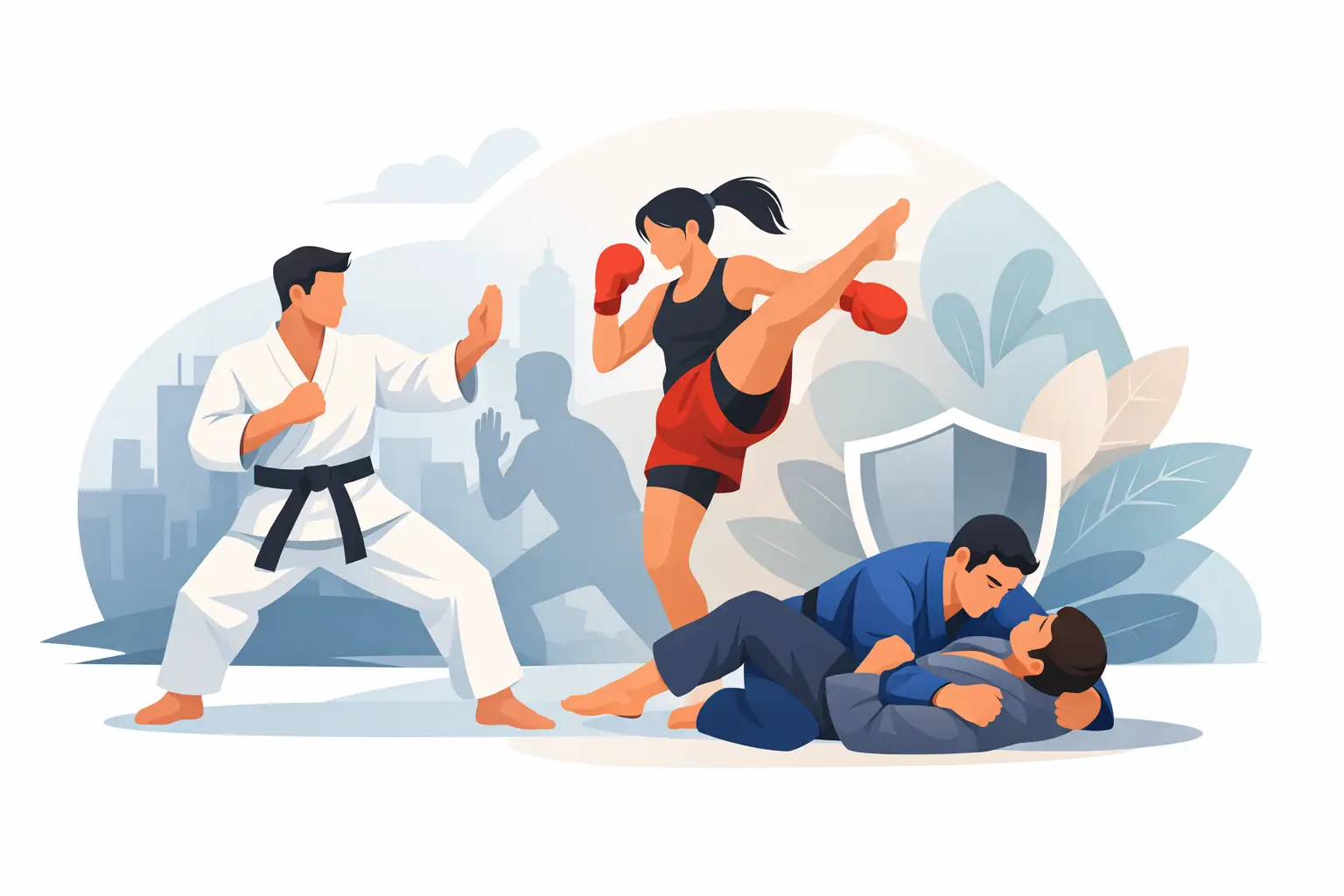
If your goal is real self-protection, not medals, forms or flashy kicks, the question is not which style looks best. It is which training gives you the best chance of staying safe under pressure. That is why so many people ask about the best martial arts for self defence – and why the honest answer is more nuanced than a simple top ten list.
A martial art is only useful for self-defence if it prepares you for the conditions that make real violence difficult: surprise, close distance, stress, uneven surfaces, limited space and the fact that most people are not wearing gloves in a matted hall. For parents, teenagers and adults starting out, that matters far more than what looks impressive on social media.
What makes the best martial arts for self defence?
Before comparing styles, it helps to be clear about what self-defence really means. It is not about winning a fight for pride. It is about awareness, decision-making, avoidance, de-escalation and, if there is no safer option, using simple effective actions to create a chance to escape.
That changes how we judge a martial art. A good self-defence system should work at close range, because many real confrontations happen suddenly and at arm’s length. It should give smaller or less athletic people useful tools, because not everyone is naturally strong, young or powerful. It should also include pressure testing, so students learn what it feels like to act when someone is resisting rather than standing still.
There is also a practical point many beginners miss. The best style on paper is not the best style for you if the teaching is poor, the classes are unsafe or the training is too complex to remember under stress. Simple training done well beats complicated training done badly.
Boxing, Muay Thai and the value of pressure
Boxing is often one of the strongest answers to the self-defence question. It teaches timing, distance, movement and the ability to hit with accuracy under pressure. Students quickly learn what it feels like to face a live opponent, and that alone builds composure.
Its limitation is also clear. Boxing focuses on punches and a sporting rule set. It does not address kicks, grabs, clinch work in depth, weapons or multiple attackers in any complete way. Even so, for developing sharp hands, awareness of range and calmness under stress, it remains highly effective.
Muay Thai adds knees, elbows, kicks and clinch work, which can make it feel closer to the chaos of a real altercation. It is tough, direct and proven. The trade-off is that some of its strongest tools are trained for a ring environment, and high-level athletic striking can be demanding for complete beginners or older students.
For fit adults who want hard conditioning and realistic striking, both are valuable. For someone looking for a broader self-defence framework, they may need to be supplemented by training that deals more directly with close-range civilian scenarios.
Brazilian Jiu-Jitsu and the reality of grappling
Brazilian Jiu-Jitsu deserves respect because it covers a range many striking arts can neglect. If someone grabs you, drives into you or forces you to the ground, grappling matters. BJJ teaches control, escapes, positioning and the ability to stay calm in physically uncomfortable situations.
That makes it useful, especially since many real confrontations become messy very quickly. A person with no grappling experience can feel completely overwhelmed once they are clinched or pinned.
But there are trade-offs. Going to the ground in self-defence is risky if there are multiple people involved, hard surfaces or unknown hazards nearby. Sport-focused BJJ can also build habits that work brilliantly in a gym but are less suitable when strikes are involved. As part of a rounded skill set, grappling is excellent. As a complete answer to self-defence on its own, it has limits.
Judo, wrestling and standing control
Judo and wrestling are often underrated in conversations about self-defence. Both teach balance, pressure, posture and control of another person’s body. If somebody grabs hold of you, shoves you or tries to overpower you at close range, these skills are extremely useful.
Judo has the added benefit of teaching breakfalls and throws, which can improve confidence and body awareness. Wrestling develops intensity and physical control in a very direct way. Both are proven, functional and honest because they rely on live resistance.
The obvious caution is context. Throwing someone onto concrete can have serious consequences, and if you are not careful, going into a grappling exchange can tie you up longer than is safe. These arts are powerful, but they need sound judgement around when and how to use them.
Krav Maga and the appeal of self-defence branding
Krav Maga is often marketed as the answer for modern self-defence. The appeal is obvious. It tends to focus on simple gross-motor actions, awareness, aggression when needed and common threat scenarios rather than sport competition.
At its best, this can be very useful. Training that includes verbal skills, boundary setting, pre-fight cues and escape-based thinking is highly relevant for ordinary people.
The challenge is consistency. Krav Maga quality varies enormously from one club to another. Some schools pressure test properly and train realistically. Others rely too heavily on compliant drills that feel convincing in class but do not hold up under pressure. With a self-defence branded system, the instructor and training method matter as much as the name on the door.
Kung Fu and why style is not the whole story
Kung Fu is often misunderstood. Some people picture elaborate forms and tradition-heavy training with little real-world application. That can happen in some schools, but it is not the full picture.
A practical Kung Fu system, especially one built around close-range fighting, direct striking, structure, reactions and economical movement, can be highly effective for self-defence. This is particularly true when the training strips away the theatrical side and focuses on pressure, timing and realistic application.
That is where systems rooted in Wing Chun principles can be valuable. Close-range efficiency, direct lines, simultaneous attack and defence, and the ability to respond quickly in tight spaces all suit civilian self-defence well. The key, again, is how it is taught. If students spend all their time on choreography, the benefits are limited. If they train simple high-percentage actions against resistance, the results are very different.
At Fusion Kung Fu, that practical approach is central. The emphasis is on what works for modern self-defence, not on preserving rituals for their own sake. For beginners, parents and teenagers, that matters because useful training should feel accessible, structured and grounded in real life.
So, what is the best martial art for self defence?
If you want the most honest answer, there is no single best martial art for self defence in every situation and for every person. There are, however, clear patterns.
Arts that consistently perform well tend to share a few features. They train with resistance. They prepare students for close-range pressure. They favour simple actions over complicated sequences. They build awareness and judgement, not just technique. And they can be used by ordinary people, not only exceptional athletes.
For pure striking pressure, boxing and Muay Thai are strong choices. For grappling and control, Brazilian Jiu-Jitsu, judo and wrestling all offer real value. For self-defence-specific training, a well-taught practical system such as Krav Maga or functional close-range Kung Fu can be an excellent fit.
What matters most is not chasing a perfect label. It is finding training that is realistic, well coached and sustainable enough for you to stick with. A teenager who trains twice a week for a year in a practical class will be far better prepared than someone who spends months researching styles and never starts.
How to choose a school, not just a style
For most people in Norwich and beyond, the better question is not, “Which martial art wins the argument online?” It is, “Where can I train consistently with good instruction?” A quality school should make beginners feel welcome without watering down the purpose of the training.
Watch how the class is run. Are students learning awareness, positioning and control, or just memorising sequences? Is there structure and discipline? Do instructors explain why a technique works, not just what to copy? Are teenagers and adults pushed appropriately but safely? Those signs tell you far more than the badge on the uniform.
It is also worth being realistic about your own goals. If you mainly want confidence, practical self-defence, fitness and a supportive environment, you may not need a competition-focused gym. If you thrive on hard sparring and athletic challenge, you might prefer one. Neither is automatically right or wrong. It depends on what will keep you training.
The best self-defence training should leave you more switched on, more composed and more capable, not just more tired. It should build confidence without false bravado. It should help young people with discipline and resilience, and give adults a clear way to improve steadily, regardless of their starting point.
If you are choosing where to begin, look for training that is practical, honest and taught by people who care whether it works. The right martial art is the one that helps you stay calm, act decisively and go home safe.
About the Author: Keith Ratcliffe
