Here’s What We Cover
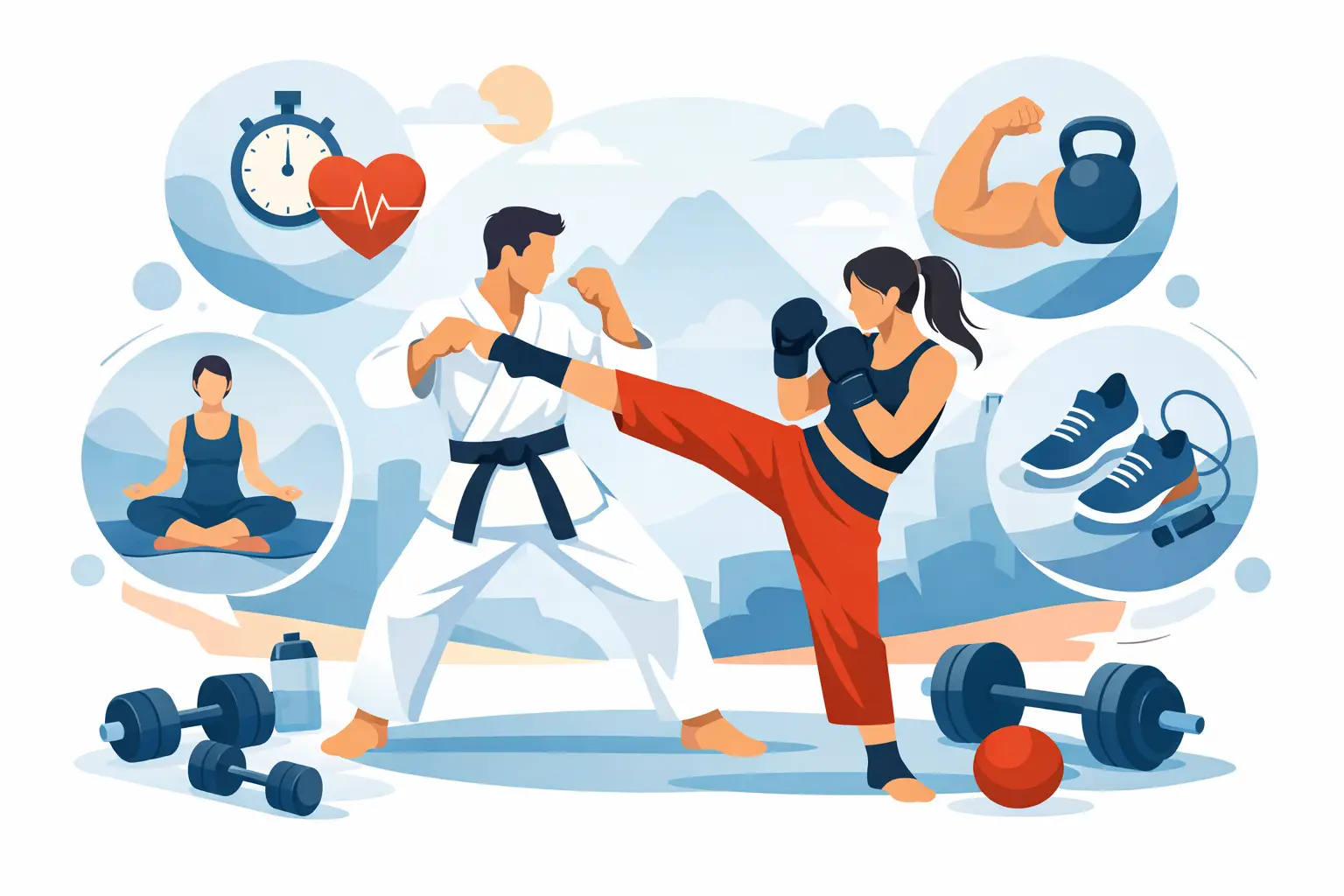
Most people start martial arts because they want to get fitter, feel safer, or build confidence. What often surprises them is how quickly training begins to improve everyday energy, movement and mental sharpness. The fitness benefits of martial arts go well beyond burning calories. Done properly, it gives you a practical way to build strength, stamina, coordination and resilience at the same time.
That matters if you are tired of exercise that feels repetitive or disconnected from real life. Hitting a treadmill for half an hour can improve cardiovascular health, but it does not teach timing, balance or composure under pressure. Martial arts training asks more of you. It trains the body and mind together, which is one reason people often stick with it for longer than a standard gym routine.
Why the fitness benefits of martial arts feel different
A lot of fitness programmes focus on one quality at a time. You might do weights for strength, running for endurance and stretching for mobility. Martial arts combines these in a more rounded way. In one session you may work footwork, striking mechanics, reaction drills, pad work and controlled partner exercises. That creates a fuller training effect without making fitness feel like a separate chore.
There is also a strong skill element. When you are learning something useful, you tend to train with more intent. Instead of counting down minutes, you are concentrating on movement, timing and control. For many beginners, that makes a real difference. The session feels purposeful, and consistency usually follows.
1. Better cardiovascular fitness without mindless cardio
Martial arts can raise your heart rate quickly, but not in the same repetitive way as steady-state cardio. Short bursts of movement, rounds on pads, footwork drills and partner training all challenge the heart and lungs. Over time, that can improve stamina and recovery.
The advantage is variety. You are not simply pushing through boredom. Your attention stays engaged because the work changes pace and direction. For teenagers and adults who struggle to stay interested in traditional fitness plans, that makes martial arts a more sustainable route to better cardiovascular health.
It is worth being realistic, though. Not every class feels like an all-out conditioning circuit, and that is a good thing. Some sessions focus more on technique and precision. The long-term benefit comes from regular training, not from trying to exhaust yourself every time.
2. Functional strength that carries into daily life
Martial arts develops strength in a practical way. You use your legs for stance and movement, your core for balance and power transfer, and your upper body for structure, control and impact. Because these parts of the body work together, the strength you build tends to feel more usable in everyday life.
This is especially helpful for people who do not enjoy the gym environment or are put off by heavy lifting. You do not need to be naturally strong to start. Strength develops through repetition, correct technique and controlled resistance.
In a practical system such as Shiyong Kung Fu, the emphasis is not on flashy movements or acrobatics. The goal is efficient movement at close range, with techniques that rely on timing, structure and body mechanics rather than size alone. That makes training accessible to a wider range of people while still building genuine physical capability.
3. Improved mobility and joint control
Good martial arts training is not just about hitting harder or moving faster. It also teaches you to move cleanly. That means better posture, stronger stances, improved hip and shoulder mobility, and more awareness of how your body is aligned.
For people who spend long hours sitting at a desk, driving, or looking down at a phone, this can be a major benefit. Training encourages you to stand properly, turn efficiently and generate movement from the whole body instead of relying on isolated muscles.
There is a balance to get right here. Mobility is useful, but forcing flexibility is not. A sensible class develops range of movement gradually, with control. That is safer and more practical than chasing extreme flexibility that has little relevance to real self-defence or long-term fitness.
4. Stronger coordination, balance and reaction speed
One of the most overlooked fitness benefits of martial arts is how much it improves coordination. You are learning to move hands, feet, eyes and body position together. That takes concentration at first, but over time it becomes more natural.
Better coordination can help in ways people do not always expect. You may feel lighter on your feet, more balanced when changing direction, and more in control of your body overall. For teenagers, this can support general athletic ability. For adults, it can make movement feel sharper and more confident.
Reaction speed improves as well, but not in a gimmicky way. It is less about superhuman reflexes and more about reading movement sooner and responding with better timing. That has clear self-defence value, but it is also a useful part of physical fitness in its own right.
5. Core strength and posture
A strong core is not just about visible abs. In martial arts, core strength helps you stay balanced, absorb force, change direction and deliver techniques with control. Nearly every drill depends on it.
This kind of core work tends to be more integrated than traditional abdominal training. Rather than isolating one muscle group, martial arts teaches the trunk, hips and lower back to work together. That can lead to better posture and less stiffness, particularly for people with sedentary jobs or screen-heavy routines.
Again, technique matters. Throwing yourself around with poor alignment can create strain instead of strength. Good coaching keeps the work controlled and progressive, so students build stability before speed.
6. Healthy weight management and body composition
If your main goal is weight loss, martial arts can help, but it is best seen as part of the bigger picture. Regular training burns energy, builds muscle and encourages consistency. Those three factors can improve body composition over time.
What makes martial arts effective for many people is adherence. A training method only works if you keep showing up. Because classes are structured, social and skill-based, people are often more likely to stay committed than they would be with an isolated solo routine.
That said, results still depend on sleep, diet and frequency of training. Two classes a week will help, but expectations should stay realistic. Martial arts is not a quick fix. It is a sustainable way to become fitter, stronger and more active over the long term.
7. Reduced stress and better mental fitness
Physical fitness is only part of the picture. Many students notice that training helps them switch off from work, school and daily pressure. When you are focused on timing, distance and technique, there is less room for mental clutter.
That can reduce stress in a very practical way. You are moving, breathing, concentrating and releasing tension through purposeful effort. By the end of class, people often feel clearer and more settled than when they arrived.
For teenagers especially, this can be valuable. Martial arts gives them structure, challenge and a healthy outlet for energy. For adults, it can provide the same benefit after a long day – not as escapism, but as disciplined reset time.
8. Confidence to train, even if you are not sporty
A common barrier is the belief that martial arts is only for naturally athletic people. In reality, good training should meet you where you are. Fitness improves because you train, not because you arrive already fit.
That is one reason martial arts appeals to so many beginners. Progress is built step by step. You improve your stance, then your movement, then your timing and conditioning. Small gains add up, and confidence tends to grow alongside them.
This matters for parents looking at options for teenagers as well. Training can help young people who are shy, inactive or lacking confidence in PE settings. The right class gives them structure and encouragement without making them feel left behind.
9. Long-term motivation through purposeful training
The best fitness plan is the one you can maintain. Martial arts has an advantage here because there is always something to improve. You are not just repeating the same workout and hoping for the best. You are building skill, discipline and physical ability together.
That sense of progression keeps people engaged. Beginners can see clear steps forward, and more experienced students continue refining their movement, speed and control. The result is a form of exercise that can stay relevant for years.
At Fusion Kung Fu, that practical mindset matters. Training should be accessible, effective and grounded in real-world use, not wrapped in unnecessary tradition. For people in Norwich who want fitness with purpose, that makes martial arts a strong choice.
Is martial arts enough on its own?
Sometimes yes, sometimes no. It depends on your goals. If you want better overall fitness, mobility, stamina and functional strength, regular martial arts training can cover a lot. If you have a very specific goal such as maximal muscle gain, competitive endurance or rehabilitation from an injury, you may need extra support around it.
What martial arts does exceptionally well is make fitness meaningful. You are not training for numbers on a machine alone. You are learning to move with control, stay calm under pressure and develop a stronger body in a practical setting.
If you have been putting off exercise because gyms feel dull, intimidating or hard to stick with, martial arts offers a different path. Start where you are, train consistently, and let the results build through honest work.
About the Author: Keith Ratcliffe
