Here’s What We Cover
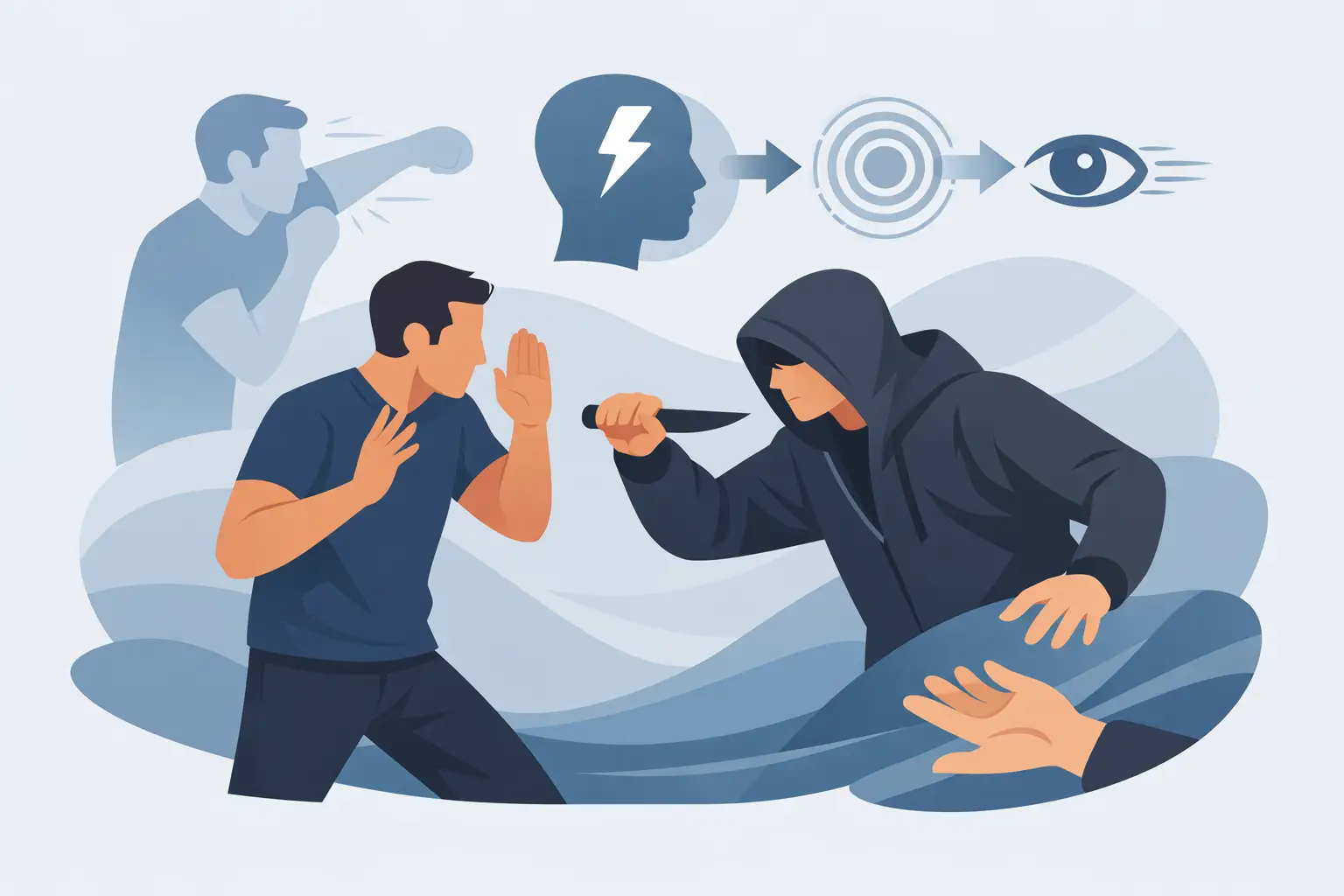
A confrontation does not wait for you to feel ready. Someone steps too close, grabs an arm, throws an unexpected shove or changes their behaviour in a second. Knowing how to improve reaction timing is not about trying to become superhuman. It is about noticing danger sooner, choosing a simple response and training that response until it becomes more reliable under pressure.
For teenagers and adults, better reactions can help with self-defence, sport, confidence and everyday awareness. For parents, it is also reassuring to know that a young person can learn to stay composed rather than freeze or panic. Good timing is not reserved for naturally quick or athletic people. It is a skill built through focused, safe practice.
Reaction speed is only part of the picture
People often think slow reactions are the problem. Sometimes they are, but pure speed is only one piece of the puzzle. In a real situation, the brain first has to spot what is happening, recognise whether it is a threat, decide what to do and then tell the body to move. If any part of that process is unclear, your response will be delayed.
This is why practical martial arts training does not rely on complicated routines. Under stress, most people will not remember a long sequence of moves. They need a clear, direct action that creates space, protects them and gives them the chance to get away safely.
Reaction timing also means acting neither too early nor too late. Move too soon and you may overreact to something harmless, lose balance or reveal your intention. Move too late and you may be caught in a bad position. The aim is to read the situation well and respond at the right moment.
How to improve reaction timing through awareness
The quickest response is often the one that starts before contact is made. Awareness gives you extra time. This is not about living in fear or assuming the worst of everyone around you. It means paying attention to distance, behaviour and changes in a person’s body language.
Notice if someone keeps closing the gap after you have moved away, blocks your path, watches your hands, clenches their fists, squares up or becomes unusually loud and aggressive. These signals do not guarantee an attack, but they may tell you to create space, position yourself near an exit or put your hands up in a calm, non-threatening protective position.
For younger students dealing with bullying, awareness includes recognising patterns. A problem rarely starts with a punch. It can begin with teasing, crowding, unwanted contact or being isolated from friends. Acting early might mean walking away, using a firm voice, seeking staff support or staying with others. That is good judgement, not weakness.
Awareness can be trained in normal life. When walking through a car park, entering a shop or waiting for a bus, briefly note where the exits are and who is around you. Do not become distracted by your mobile phone when you need to move through a public space. These small habits make observation more natural without making daily life stressful.
Train simple responses, not clever ones
A practical response needs to work when your heart rate rises and your thinking becomes less clear. This is why simple movements are usually the best place to start. A strong stance, hands protecting the head and centreline, moving off the line, creating distance and using direct strikes or escapes are more useful than trying to memorise flashy techniques.
Repetition matters, but mindless repetition does not. If a partner always attacks from the same angle, at the same speed and with the same rhythm, you may become good at predicting them rather than reacting. Start slowly so you can learn correct positioning, then gradually add variation.
A training partner might change the distance, timing or side of an incoming touch or controlled strike. Your job is to stay relaxed, see the cue and use one simple defensive action. At first, it can feel frustratingly slow. That is normal. Trying to rush usually creates tension, and tension makes you slower.
In Shiyong Kung Fu training, drills should have a clear purpose: protect yourself at close range, improve your position and respond with control. There is no benefit in collecting techniques that look impressive but are difficult to use when surprised.
Use progressive pressure
Pressure should build in stages. Begin with cooperative drills where both people understand the attack and response. Then introduce choices, such as a left or right hand, a push or a grab. Later, add verbal distraction, movement and controlled resistance.
The goal is not to frighten beginners or turn every lesson into a brawl. It is to make training realistic enough that students learn to think and move when the situation is not perfectly predictable. Good coaching keeps this challenging while protecting confidence and safety.
Practise drills that force a decision
Reaction timing improves when a drill requires you to notice and choose, rather than simply perform a pre-planned pattern. You do not need expensive equipment to begin. Work with a qualified instructor or a responsible training partner, keep contact controlled and use appropriate protective equipment when required.
Useful examples include:
- A partner gives a visual cue with either hand, and you respond with the correct cover, parry or movement.
- A partner steps forwards at different speeds, and you practise judging distance before moving, blocking or creating space.
- A call-and-response drill uses simple verbal commands, helping you listen and react without staring at one target.
- A light touch drill at close range teaches you to feel pressure, maintain balance and respond without relying only on sight.
The last example is especially valuable in close-range martial arts. Not every threat gives you a clear view. Someone may be too near, your vision may be obstructed or the situation may happen in poor light. Sensitivity, posture and balance help you react when sight alone is not enough.
Keep rounds short. Twenty to forty seconds of focused work is often more productive than several minutes of tired, sloppy movement. Rest, discuss what happened, then repeat. Quality practice teaches the nervous system more effectively than simply exhausting yourself.
Stay relaxed enough to move
Many people freeze because they tense every muscle as soon as they feel pressure. A degree of tension is natural, but excessive tension slows the arms, locks the shoulders and makes footwork heavy. You may see the attack but still feel unable to respond cleanly.
Breathing is a practical tool here. During drills, avoid holding your breath. A short exhale as you move can help you stay grounded and prevents you from becoming rigid. Keep your knees soft, your hands in a useful position and your eyes open. Looking away or closing your eyes when a strike comes towards you is a common protective reflex, but it can be improved through gradual, controlled training.
Calm does not mean passive. It means being able to act without wasting movement. A person who is relaxed and alert will often respond faster than someone who is physically stronger but panicking.
Build the foundations away from the class floor
Reaction drills work best when your basic fitness supports them. You do not need to train like a professional fighter, but poor sleep, low energy and limited mobility can affect concentration and coordination.
Regular walking, bodyweight strength work, mobility training and steady cardiovascular exercise can all help. Stronger legs improve your ability to move and stay balanced. Better shoulder mobility can make protective movements more natural. General fitness also helps you recover faster during training, so you can maintain good decisions for longer.
Sleep deserves particular attention for teenagers, busy parents and adults managing work pressures. When you are tired, attention narrows and reaction time drops. A late night on screens followed by a demanding day is not the ideal condition for sharp decision-making. Better rest will not replace training, but it gives your training a stronger base.
Measure progress in the right way
Do not judge progress only by whether you can react to a fast hand. Look for better posture, earlier recognition of cues, fewer moments of panic and cleaner movement under pressure. You may also notice that you stop flinching as much, keep your balance more easily and recover faster after making a mistake.
There will be days when your timing feels off. Stress, tiredness and unfamiliar partners all affect performance. That does not mean you are going backwards. Consistent training teaches you to adapt rather than depend on feeling perfect.
At Fusion Kung Fu, students train these skills in a structured, supportive environment where beginners can learn at their own pace and develop confidence through practical repetition. The focus is on effective movement, sensible decision-making and techniques that suit real people, not just the naturally athletic.
Better reaction timing is built one controlled repetition at a time. Stay observant, keep your responses simple and give yourself permission to learn slowly. When the pressure rises, the habits you have practised calmly are the ones most likely to be there for you.
About the Author: Keith Ratcliffe
