Here’s What We Cover
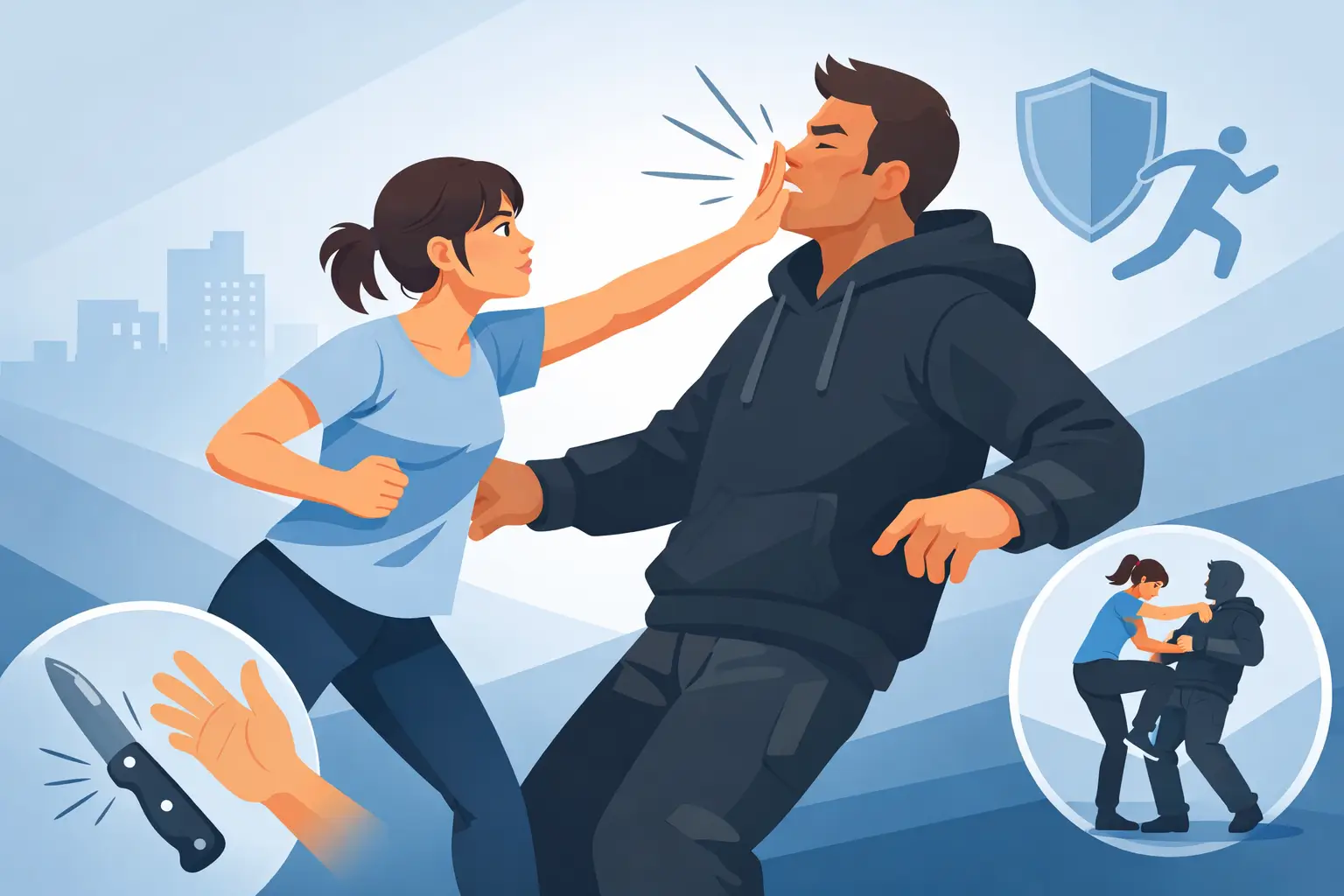
If you are smaller than the person in front of you, bad advice shows up quickly. “Just hit harder” is useless. “Use your weight” only goes so far if the attacker has far more of it. Real self defence for smaller adults has to be built around leverage, timing, position and decision-making under pressure.
That is exactly why good training matters. Size does matter in a fight. Strength matters too. Pretending otherwise helps nobody. But that does not mean a smaller adult is helpless. It means your training needs to be realistic, efficient and focused on the moments that give you the best chance to protect yourself and get away safely.
What self defence for smaller adults really means
For a smaller person, self-defence is rarely about standing toe to toe and trying to outmuscle someone. It is about disrupting their attack, protecting vulnerable targets, creating space and escaping. The aim is not to win an argument or prove toughness. The aim is to go home safely.
That changes the whole approach. Techniques need to work at close range, under stress and against someone who may be stronger, heavier and more aggressive. Fine motor tricks tend to fall apart when adrenaline hits. Complicated sequences are hard to apply when someone is grabbing, rushing or swinging wildly. The best methods are usually simple, direct and repeatable.
A practical system should also teach what happens before physical contact. Awareness, posture, verbal boundaries and positioning often matter more than the strike itself. If you can spot trouble early, avoid being cornered and move decisively, you may never need to fight at all.
The biggest mistake smaller adults make
Many beginners assume self-defence starts when a punch is thrown. In reality, the problem often starts much earlier – with distance, hesitation and poor positioning.
A stronger attacker usually wants to close in fast, grab hold, bully, shove or overwhelm. If you freeze, back straight up or let them dominate your balance, the situation gets worse quickly. Smaller adults benefit from training that teaches them how to manage range, keep their base under them and respond immediately rather than waiting to see what happens next.
There is also a mental trap. Some people think being smaller means they should stay passive for as long as possible. Of course restraint matters, and the law matters, but there is a difference between avoiding escalation and doing nothing while the danger grows. Good self-defence training helps you recognise that point clearly.
Why close-range skills matter most
Most real confrontations do not look like choreographed sparring. They are messy, sudden and close. Someone gets in your face, grabs clothing, blocks your path, pushes you against a wall or reaches for your arms. For smaller adults, this is where practical close-range training becomes valuable.
At close distance, speed, structure and targeting can reduce some of the advantages that come with raw size. If your posture is strong and your movement is efficient, you can strike vulnerable areas, break the other person’s rhythm and create the opening you need to leave. That is very different from trying to trade big shots from a distance.
This is one reason styles built around direct movement and economy can suit smaller students well. They do not ask you to be the strongest person in the room. They ask you to react quickly, stay balanced and use techniques that make sense when space is limited.
What actually helps a smaller person in a real situation
The answer is not one magic move. It is a set of habits developed through regular practice.
First, balance and structure matter enormously. If your stance collapses under pressure, your technique usually goes with it. A smaller adult who can stay grounded, protect their centre and move without overreaching is already in a better position than someone relying on aggression alone.
Second, targeting matters. In self-defence, you are not trying to score points. You are trying to interrupt the attack. That means training to hit sensible targets quickly and with intent, especially when under pressure.
Third, timing often beats force. A well-timed response as someone moves in can be far more effective than a stronger response delivered too late. This is why drilling matters. You are teaching your body to act at the right moment, not just learning a shape.
Fourth, decision-making under stress is vital. Not every threat is the same. Sometimes the right answer is to leave early. Sometimes it is to de-escalate verbally. Sometimes you need a fast physical response and immediate escape. Good instruction helps you judge that without filling your head with fantasy scenarios.
Training should be honest, not theatrical
If you are looking for self defence for smaller adults, be wary of anything that depends on perfect conditions. A compliant partner, a slow attack and a neat finish can make almost any technique look convincing. That does not mean it will hold up when someone is resisting.
Useful training includes pressure, movement and unpredictability. That does not mean dangerous free-for-all sessions for beginners. It means building skills in a sensible way so that students learn what works when things are untidy.
It also means accepting trade-offs. No method works every time. No instructor can honestly promise that size will never be a factor. What training can do is improve your odds, sharpen your awareness and give you practical responses that are far better than panic.
At Fusion Kung Fu, this practical mindset is central to how self-defence is taught. The focus is on what works in modern situations, especially at close range, rather than tradition for tradition’s sake.
Self-defence for smaller adults is also about mindset
Physical skill matters, but mindset often decides whether that skill appears when needed. Smaller adults sometimes spend years being told, directly or indirectly, that they are physically disadvantaged and should avoid confrontation at all costs. Avoiding trouble is sensible. Feeling powerless is not.
Training can change that. Not by creating false confidence, but by replacing uncertainty with experience. When you have practised boundary setting, movement, striking, escapes and scenario work, you stop seeing yourself as easy to overwhelm. You become calmer because you are not guessing.
That calm matters. Panic leads to hesitation, and hesitation gives an aggressive person momentum. A trained student is not fearless. They are simply more prepared to recognise danger and act with purpose.
What beginners should look for in a class
If you are a smaller adult starting martial arts for self-defence, look for a class that welcomes beginners and explains things clearly. You should not need to be fit, flexible or naturally tough to get started. In fact, a good school expects complete beginners and knows how to build them up properly.
You also want instruction that is structured. Random techniques do not create reliable self-defence. Progressive training does. Basics first, then pressure, then application. That is how confidence becomes real rather than imagined.
Pay attention to the atmosphere as well. Serious training does not need to be intimidating. The best clubs are disciplined, supportive and focused. Students should be pushed, but safely. Questions should be answered. Progress should feel earned.
For teenagers, adults returning to training and parents thinking about starting themselves, this matters even more. Many people rule themselves out before they begin because they assume martial arts is only for naturally athletic people. It is not. The right training meets you where you are and develops you from there.
Progress is built through repetition
One session can open your eyes. Consistent training changes you.
Over time, smaller adults develop sharper reactions, better coordination, stronger posture and greater confidence under pressure. They also build fitness in a way that has a clear purpose. You are not just exercising for the sake of it. You are learning to move well, stay composed and handle physical pressure more effectively.
That process is especially valuable because self-defence is not only about the worst-case scenario. It affects how you carry yourself every day. Better awareness, stronger presence and more confidence in your own boundaries can change the way you move through the world.
If you are smaller, that does not mean self-defence is beyond you. It means your training needs to be smarter. Focus on awareness, close-range effectiveness, timing, balance and simple techniques you can rely on under stress. Start with honest instruction, train consistently and give yourself time to improve. Practical skill grows step by step, and that first step is often the one that changes everything.
About the Author: Keith Ratcliffe
