Here’s What We Cover
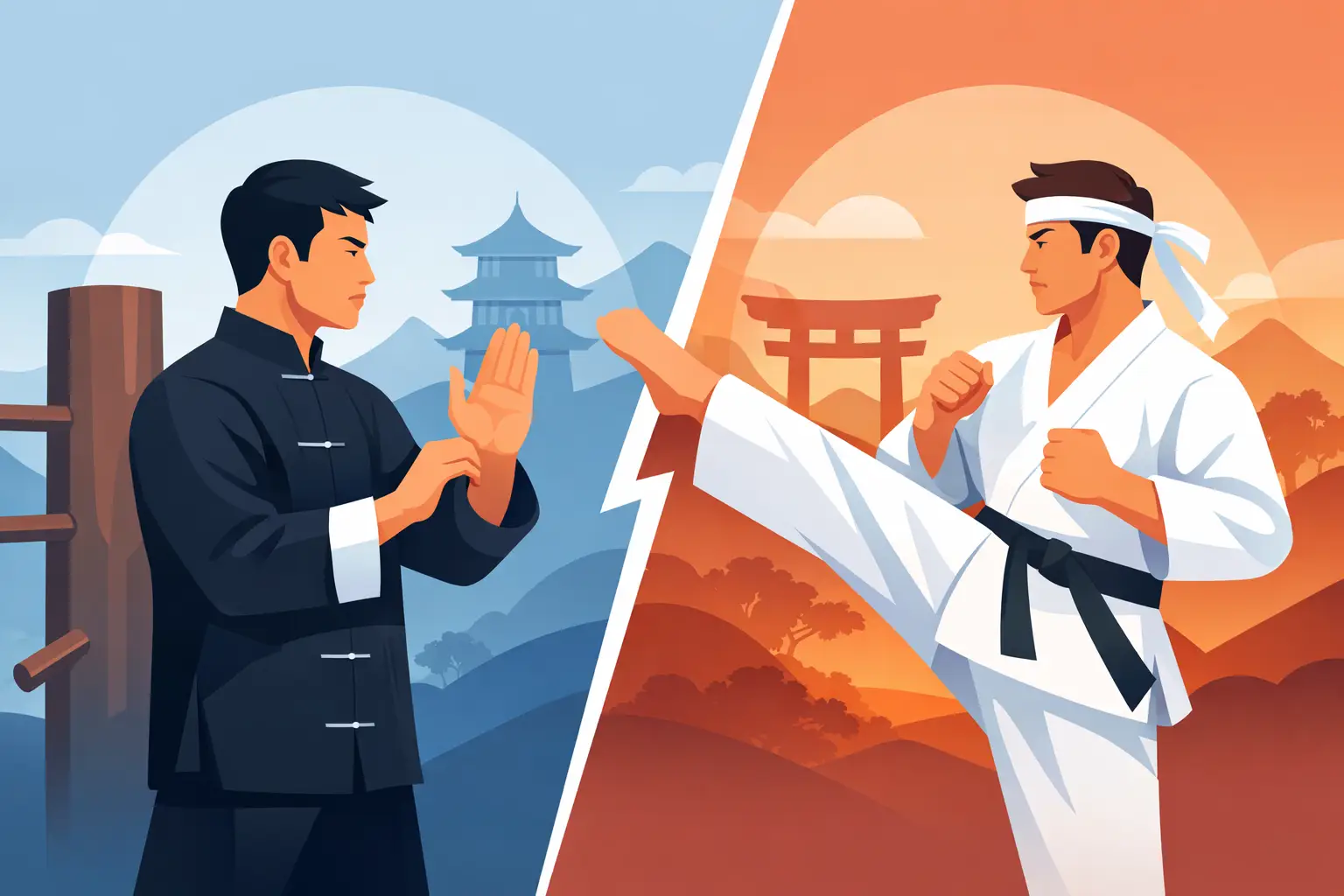
If you are weighing up wing chun vs karate, you are probably not looking for a history lesson. You want to know which one is more useful, which one is easier to start, and which one actually suits your body, goals and mindset.
That is the right question to ask. Too many martial arts comparisons get stuck on style loyalty, grading systems or tradition. For most beginners, and for many parents choosing classes for a teenager, the real issue is simpler: will this training help with confidence, fitness, discipline and practical self-defence?
Wing Chun vs Karate at a glance
Wing Chun and Karate are both respected martial arts, but they are built around very different ideas. Wing Chun is known for close-range efficiency, direct striking, pressure, trapping and quick reactions. Karate is a broader category with different styles, but most people recognise it for stronger use of distance, linear strikes, blocks, stances and powerful basics.
In plain terms, Wing Chun often tries to end an exchange quickly at close quarters. Karate often places more emphasis on timing, distance and generating force through clean technique. Neither is automatically better. It depends on how you want to train and what you need from it.
The biggest difference is range
If you watch both styles side by side, the first major contrast is range. Wing Chun is designed to work when someone is right in front of you. It focuses on short, direct movement with minimal wasted motion. That can make it appealing for self-defence, because real confrontations do not usually begin with lots of space and tidy footwork. They tend to be messy, sudden and close.
Karate, depending on style and school, often develops striking from a longer or mid-range distance. There is usually a strong focus on clean entry, strong posture and committed technique. That can build excellent discipline and sharp fundamentals, but it may feel more structured and formal in comparison.
For a beginner, this affects the training experience straight away. Wing Chun can feel compact and practical from the start. Karate can feel more methodical, with a clear emphasis on drilling basics until they become second nature.
How they approach self-defence
This is where the wing chun vs karate debate becomes more personal.
Wing Chun is often attractive to people who want practical self-defence without relying on strength, flexibility or athleticism. The mechanics aim to make efficient use of body structure, positioning and speed. Rather than exchanging big shots from a distance, it works to control the centreline, apply pressure and disrupt the opponent quickly.
Karate can absolutely build self-defence ability too, especially when taught by instructors who focus on application rather than performance. Strong striking, awareness, distance management and timing all matter in real situations. The issue is not whether Karate can work. The issue is how the school teaches it.
That matters because some Karate clubs lean heavily towards sport, forms or traditional routines. There is nothing wrong with that if those are your goals. But if your priority is realistic self-protection, you need training that addresses pressure, unpredictability and what happens when things are not tidy.
The same warning applies to Wing Chun as well. Some clubs teach it in a way that becomes too theoretical or compliant. A practical martial art still needs practical training.
Which is easier for beginners?
Most beginners find that Karate offers a very clear structure. You learn stances, strikes, blocks, patterns and combinations step by step. For many students, especially children and teenagers, that can be helpful. The progression feels organised, and the discipline of repetition builds confidence.
Wing Chun can also be beginner-friendly, but in a different way. It tends to suit people who want straightforward movement and practical application early on. Because it does not depend on high kicks or acrobatic movement, many adults find it more accessible than they expected.
If someone feels put off by flashy martial arts or worries that they are not naturally sporty, Wing Chun can be a strong fit. It often feels more realistic and less intimidating. You do not need to be tall, strong or fast to begin learning useful principles.
Fitness, discipline and personal development
Karate has a long reputation for developing discipline, respect and mental focus. That reputation is well earned. Repetition, posture, control and technical standards can teach patience and self-control, which is one reason many parents like it for young people.
Wing Chun develops those qualities too, but through a different training style. It places a lot of value on sensitivity, timing, awareness and staying calm under pressure. Students often discover that the biggest lesson is not brute force, but composure. That can be powerful for teenagers and adults who want greater confidence without becoming aggressive.
In terms of fitness, both can improve stamina, coordination and strength. Karate may involve bigger movements and, in some classes, more visibly athletic drills. Wing Chun tends to focus on efficiency, balance, speed and endurance at close range. One is not better than the other. The better choice is the one you will stay consistent with.
Wing Chun vs Karate for smaller or less athletic students
This is one of the most common concerns, and rightly so. Many people assume martial arts only favour the naturally fit or physically gifted. Good teaching should prove otherwise.
Wing Chun is often praised for being well suited to smaller practitioners because it emphasises structure, positioning and economy of motion. The aim is not to match force with force if that can be avoided. For adults starting later in life, or teenagers who lack confidence in sport, that can make training feel achievable.
Karate can also work very well for smaller students, especially where technique is taught properly and the environment is supportive. But some people will find the larger stances, stronger impact emphasis or sport-oriented pace less natural at first.
This is why trying a class matters more than reading ten opinions online. The same martial art can feel completely different depending on how it is coached.
Tradition versus practicality
There is a point here that often gets overlooked. Some people are drawn to martial arts for heritage, ritual and formal tradition. Others want training that is stripped back to what works in modern life.
Karate schools vary widely. Some strongly preserve tradition, etiquette and classical training methods. That can be excellent for character development and respect. For some students, it is exactly what they want.
Wing Chun also carries tradition, but many modern schools present it in a more practical, functional way. For students who want realistic self-defence rather than theatrical movement or sport points, that can be a better fit.
At Fusion Kung Fu, that practical mindset matters. Training should be structured and disciplined, but it should also make sense for the world people actually live in now.
So which one should you choose?
Choose Wing Chun if you want close-range self-defence, efficient movement and training that does not rely on strength, size or flashy athletic ability. It is often a strong option for adults, teenagers and beginners who want something practical and grounded from the outset.
Choose Karate if you value a highly structured system, strong technical basics and a training culture that may include more formal tradition, patterns or sport depending on the club. It can be excellent for discipline and physical development, especially if the teaching includes realistic application as well as form.
The honest answer is that wing chun vs karate is not really about which style wins. It is about which method helps you grow, stay committed and build skills that are useful to you.
A good school will make you feel challenged but supported. It will teach discipline without ego. It will help you become fitter, calmer and more capable, not just busier collecting belts.
If you are a parent, look for an environment where your child learns confidence, respect and resilience in a safe, structured setting. If you are an adult beginner, look for training that feels achievable on day one and worthwhile six months later.
The best martial art is the one you can train consistently, with good coaching, for the right reasons. Start there, and the style choice becomes much clearer.
About the Author: Keith Ratcliffe
