Here’s What We Cover
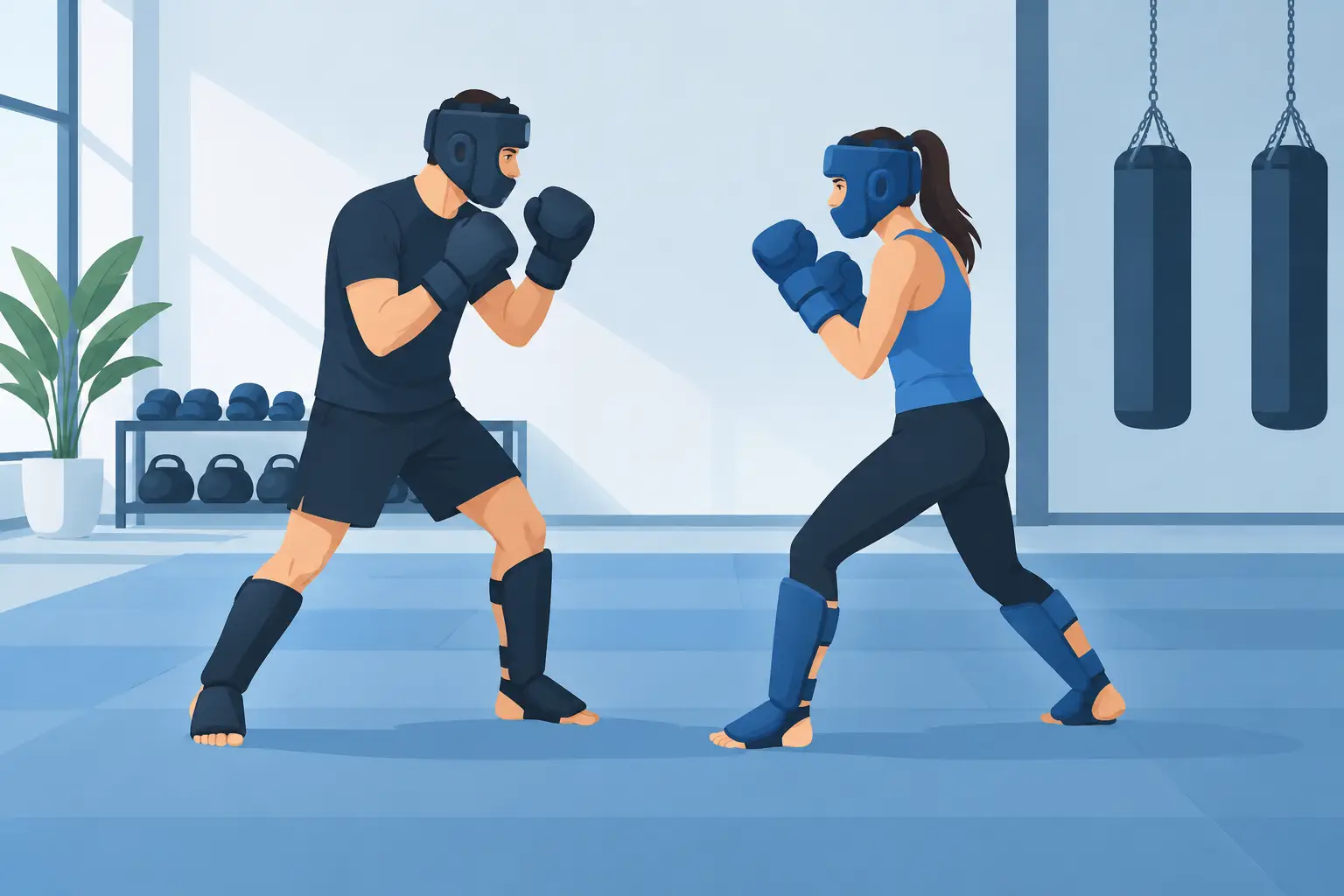
A good sparring round should leave you sharper, calmer and more aware of what you need to improve. It should not leave someone frightened to return, carrying an avoidable injury, or feeling they have something to prove. This guide to safe sparring practice explains how controlled contact helps teenagers and adults develop practical self-defence skills without turning training into a fight.
Sparring has a purpose. It tests timing, distance, balance, composure and decision-making when another person is moving and reacting. Drills teach the mechanics, but sparring shows whether you can apply them with control. Done properly, it is one of the most useful parts of martial arts training. Done carelessly, it can quickly become an ego contest that teaches poor habits.
Safety starts before contact begins
Safe sparring is decided before anyone throws a strike. Partners need a clear agreement about the aim of the round, the level of contact and the techniques that are allowed. A light technical round is not the same as a conditioning round, and neither is the same as preparing for a competition. Confusion is where many preventable accidents begin.
For beginners, the priority is usually movement, guard position and staying relaxed under gentle pressure. There is no benefit in asking someone new to absorb hard shots or trade punches before they understand distance and defence. As skills improve, the pace and resistance can increase gradually. Progression matters more than bravado.
A proper warm-up also earns its place. Raise the heart rate, mobilise the shoulders, hips and ankles, and practise a few controlled movements before contact starts. Stiff joints, cold muscles and rushed preparation make it harder to move well and easier to make poor decisions.
Set the right level of contact
Control is not weakness. It is the ability to stop a technique at the right moment, choose an appropriate target and protect your partner while still training honestly. In a practical martial arts class, that is a real skill.
Light contact should mean contact that partners can handle comfortably, not repeated heavy blows described as “light” after the fact. If a strike lands harder than intended, acknowledge it, check your partner is all right and adjust. One accidental hard shot can happen. Repeating it after being asked to ease off is unacceptable.
The right level depends on experience, size, protective equipment and the purpose of the session. A taller, stronger adult can train productively with a smaller partner, but they must use restraint and good judgement. Equally, a smaller or less experienced student should not feel obliged to match somebody else’s pace. Speak up early rather than trying to endure a round that has become unsafe.
Choose partners who help you improve
The best sparring partner is not necessarily the fastest or hardest hitter. It is somebody who can challenge you while keeping the round constructive. They respect the rules, respond when asked to reduce power and understand that both people should leave having learned something.
Training with different body types and experience levels is valuable. A taller partner teaches you about entry and distance. A quicker partner tests your reactions. A more experienced student can expose gaps in your guard and footwork without overwhelming you. The key is matching people sensibly and setting clear expectations.
If you are more experienced, your job is not to dominate every exchange. Give newer students room to practise. Use clean movement and controlled attacks rather than unpredictable pressure. You can make a round difficult without making it discouraging.
Wear suitable protective equipment
The equipment needed varies by class rules and sparring format, but protection should support safe, realistic training. Well-fitted gloves and a mouthguard are common essentials where striking is involved. Depending on the session, head protection, shin guards, groin protection and body protection may also be appropriate.
Equipment is not permission to hit harder. A mouthguard helps protect teeth and reduce some impact risks, but it does not make hard shots to the head harmless. Gloves soften impact, yet poor control can still cause injuries. Good judgement remains the main layer of protection.
Check that gloves are secure, nails are trimmed and jewellery is removed. Long hair should be tied back safely. These details may seem small, but they prevent distractions and unnecessary scratches, snags and impacts once the round begins.
Keep technique practical and controlled
Safe sparring does not mean pretending an opening is not there. It means recognising the opening, applying the appropriate response and stopping at a level your partner can safely receive. That develops accuracy far better than swinging wildly.
Maintain a sensible stance, keep your hands ready and avoid chasing every exchange with full power. Many injuries happen when students overreach, lose balance or throw techniques without regard for range. In close-range systems such as Shiyong Kung Fu, control becomes even more important because reactions happen quickly and space disappears fast.
Use clean targets agreed by the instructor. Avoid prohibited areas and do not continue striking once a partner has clearly disengaged, turned away or called stop. If a technique lands somewhere it should not, pause and reset. Respecting boundaries is part of learning functional self-defence, not a break from it.
Listen to the instructor and the room
A well-run class has rules for a reason. The instructor can see patterns that are difficult to notice when you are focused on your own movement: rising tension, mismatched partners, fatigue, unsafe technique or contact that is escalating. When they call for a reset, change the pace or stop the round, respond straight away.
Students also have a responsibility to stay aware. Do not drift into another pair, spar near hazards or keep working when the space is too crowded. If someone falls, loses protective equipment or looks hurt, stop immediately. There is no prize for carrying on while a partner is vulnerable.
At Fusion Kung Fu, sparring should support the same qualities that matter throughout training: discipline, awareness, respect and the confidence to deal with pressure without panic. Those habits are useful well beyond the training floor.
Know when to pause or sit out
Being committed to training does not mean ignoring warning signs. Stop sparring if you feel dizzy, nauseous, unusually short of breath, confused, or experience sharp pain. Tell the instructor. A headache after impact, especially following a blow to the head, should always be taken seriously rather than brushed off.
Tiredness also changes the quality of a round. As technique falls apart, reactions slow and tempers shorten, the chance of a mistake rises. Sometimes the disciplined choice is to take a breather, practise a technical drill instead or call it a day. Consistent training over months and years is more valuable than forcing one more round when your body is not responding properly.
Parents of teenage students can help by reinforcing this message. Confidence is not about hiding discomfort or refusing help. It is about making sensible decisions, communicating clearly and returning to training when it is safe to do so.
Leave ego outside the sparring area
Sparring can expose frustration. You may get caught with a clean technique, struggle to close distance, or find that your usual response does not work against a particular partner. That feedback is useful. Treat it as information, not an insult.
Avoid trying to “get one back” after being hit. Reset your guard, breathe and look for the lesson. Did you drop your hands? Did you step in without covering? Were you watching the strike instead of the person? This mindset turns sparring into problem-solving rather than a test of pride.
A respectful word after the round goes a long way. Thank your partner, mention anything that worked well and raise concerns calmly if the contact felt too heavy. Strong martial arts communities are built by people who can train hard while looking after one another.
Make every round purposeful
Random sparring often becomes messy. Give yourself one or two simple goals for each round: keep your guard on the way in, use your footwork to create an angle, stay calm after contact, or practise defending before countering. Specific goals focus the mind and reduce the urge to throw uncontrolled techniques.
You do not need to win a training round to make progress. A round where you maintained composure, protected yourself and identified one weakness is valuable. Over time, those small improvements build genuine confidence and better judgement under pressure.
Safe sparring is not about making training easy. It is about making it worthwhile. Train with control, communicate honestly, respect your partners and let your skill grow one well-managed round at a time.
About the Author: Keith Ratcliffe
