Here’s What We Cover
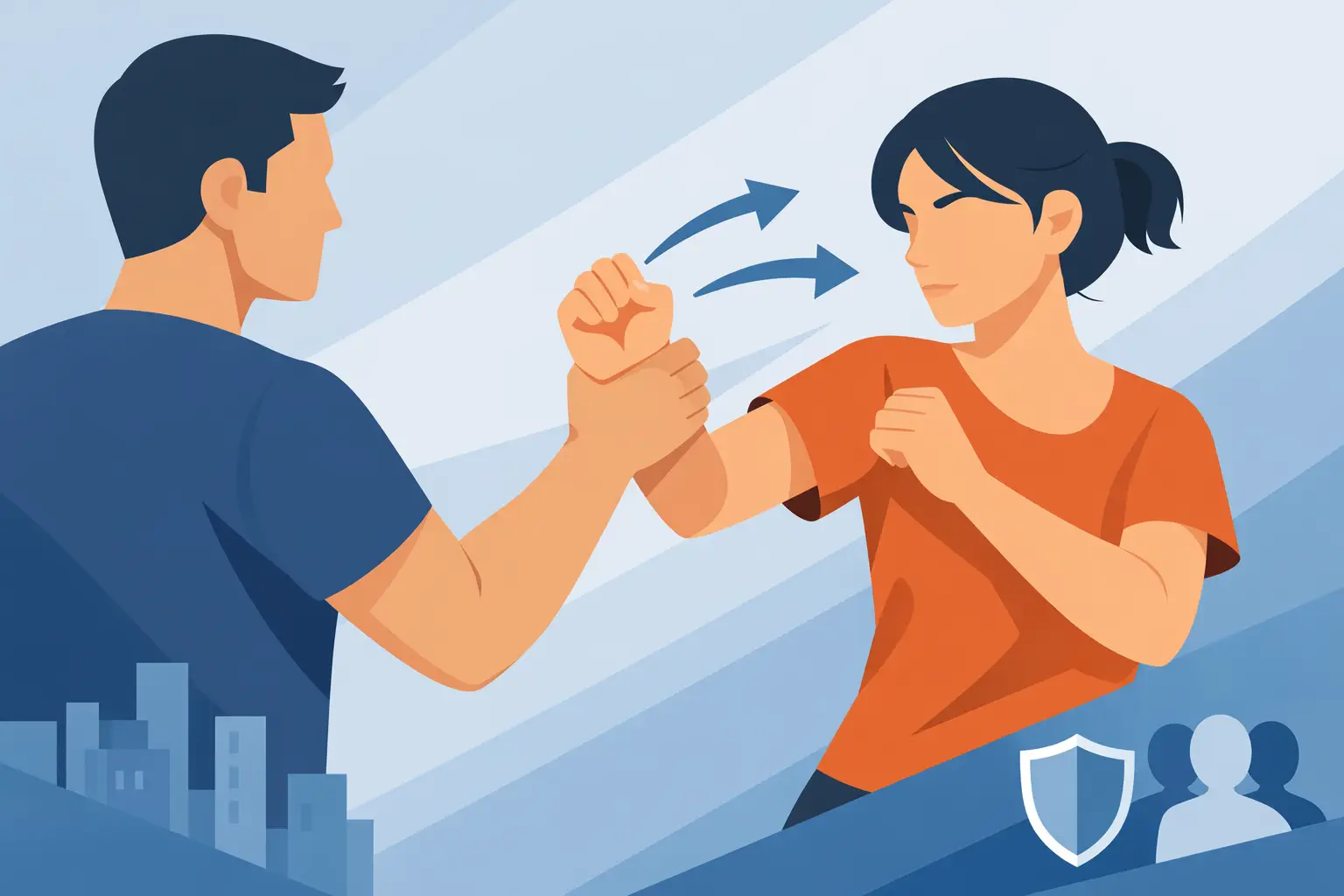
A wrist grab can happen quickly: someone stops you from walking away, pulls you towards them, or tries to control where you go. Knowing how to escape wrist grabs is not about showing off a clever move. It is about staying balanced, creating space and getting yourself to safety before the situation becomes worse.
At Fusion Kung Fu, we teach practical self-defence with a simple priority: avoid trouble where possible, escape when you can, and use only the level of force needed to protect yourself. Size and strength can help, but good positioning, timing and calm decision-making matter far more than trying to overpower someone.
Start with the right goal: escape, not win
The moment someone takes hold of your wrist, it is easy to panic and pull directly away. That is often the least effective response. Their fingers tighten, your posture breaks down and you can find yourself being dragged off balance.
Your goal is not to stand there and prove you are stronger. Your goal is to break their control, make space and leave. That change in mindset is important for teenagers, adults and parents discussing personal safety with their children. A successful escape is one that gets you away safely, not one that looks impressive.
If there is an opportunity to speak clearly, use your voice. A firm “Let go” can draw attention, set a boundary and sometimes stop the situation before physical action is needed. Keep your voice direct rather than apologetic. If you can move towards other people, a well-lit area or an exit, do so.
How to escape wrist grabs using body position
Most wrist grabs rely on the grabber using their fingers and thumb to close around the wrist. Trying to pull straight backwards means you are pulling against the strongest part of that grip. A more practical principle is to move towards the weaker opening between the thumb and fingers while using your whole body, not just your arm.
First, regain your stance. Put one foot slightly behind you, soften your knees and keep your head up. This gives you a stable base and makes it harder for someone to pull you forward. Avoid leaning back with a straight arm, as this can leave you off balance and place unnecessary strain on your shoulder.
Next, turn your wrist so the narrowest part is lined up with the space near their thumb. At the same time, step or turn your body away from the grab rather than attempting to yank your hand free with arm strength alone. The movement should be sharp and purposeful, but not wild. Your body turn and footwork provide the power.
As your hand comes free, create distance immediately. Put your hands up in a non-threatening protective position, move away and assess your route out. Do not remain close simply because the first escape worked. The person may grab again, or the situation may involve more than one person.
This principle can be practised slowly and safely with a partner. The details will vary depending on whether the grab is on the same-side wrist, across the body, with two hands, or while someone is pulling you. That is why repeating one move in the air is not enough. You need supervised practice with realistic pressure, changing angles and clear safety boundaries.
Do not rely on strength alone
A common mistake is clenching the fist, tensing the shoulder and trying to rip the wrist free. It may work against a loose hold, but it is unreliable against someone larger or more determined. It can also make you freeze when the technique fails.
Practical training teaches you to connect your feet, hips and hands. A step, turn and controlled change of angle can make a significant difference. The aim is efficiency. You are using structure and movement to reduce the other person’s control, rather than entering a strength contest.
That does not mean every escape will work perfectly first time. Real situations are unpredictable. Clothing, footwear, a slippery surface, surprise and fear all affect what is possible. A useful self-defence skill is being able to keep moving, protect your balance and try again if the first attempt does not create enough space.
What changes when you are being pulled?
A wrist grab becomes more serious when someone is trying to pull you somewhere. In that moment, your feet matter as much as your hands. If you allow your body to be pulled upright and forwards, you give away your balance. Lower your centre of gravity by bending your knees slightly and stepping into a stable position.
Turn towards the direction that helps you release the grip, then move away at once. If you are being pulled towards a vehicle, doorway, quiet area or group of people, make noise and resist being moved. Draw attention with clear words such as “I don’t know you” or “Call the police”. These phrases tell bystanders that this is not an argument between friends.
If you are already off balance, focus first on staying on your feet. It is much harder to escape, run or protect yourself from the ground. There is no shame in dropping a bag, shopping or a mobile phone if it helps you move away. Possessions can be replaced. Your safety cannot.
Situational awareness gives you more options
The best wrist-grab escape is often avoiding the grab in the first place. Awareness is not about living in fear or assuming the worst of everyone. It is about noticing what is around you and keeping practical options open.
Avoid becoming completely absorbed in your mobile phone when walking alone, especially near transport, car parks, doorways or quieter routes. Keep enough space around yourself when speaking to someone you do not know. Trust discomfort early. If someone ignores a simple request for space, moves to block your path or continues following you, move towards people and seek help before they get close enough to grab.
For younger students and teenagers, this lesson is especially useful in bullying situations. A wrist grab in a school corridor or outside the gates can be an attempt to intimidate rather than immediately injure. The response should still be calm and firm: make space, use your voice, leave the area and report what happened to a trusted adult. Physical skills support confidence, but they should sit alongside sensible reporting and support.
Why practice needs to be controlled
Wrist releases look simple until a partner applies a realistic but safe hold. Under stress, people hold their breath, forget their footwork and revert to pulling. Repetition builds a better response, but only when the practice is structured.
A good class starts with control. Partners communicate, grips are applied gradually and students learn how to tap or stop if something hurts. As confidence improves, the training can include movement, verbal pressure and different grabbing angles. This helps students understand the principle rather than memorising a rigid sequence.
It also builds composure. You do not need to be naturally athletic, large or experienced to learn effective movement. Consistent practice improves coordination, posture and the ability to think when someone invades your personal space. Those benefits carry into everyday life, from walking home to handling stressful confrontations more calmly.
Keep the response proportionate
Self-defence is about reasonable action to protect yourself or another person from immediate harm. Once you have escaped and can leave safely, leave. Chasing someone, continuing to strike or trying to punish them can turn an escape into a more dangerous situation.
After any serious incident, get somewhere safe, contact the police if appropriate and seek medical attention for injuries. Tell someone you trust what happened while the details are fresh. If the incident involved school bullying, report it clearly and keep a record of dates, messages or witnesses where possible.
Build confidence before you need it
Learning a wrist escape is useful, but confidence comes from training the full picture: awareness, stance, voice, balance, controlled movement and the judgement to get away. A technique is only one part of personal safety.
Structured martial arts training gives you a safe place to make mistakes, ask questions and improve at your own pace. You may begin by learning how your posture changes under pressure. Over time, those simple habits can help you stand more confidently, move with purpose and respond without panic.
The strongest outcome is not feeling ready for a fight. It is knowing you have practical options, the discipline to use them sensibly and the confidence to walk away when walking away is possible.
About the Author: Keith Ratcliffe
