Here’s What We Cover
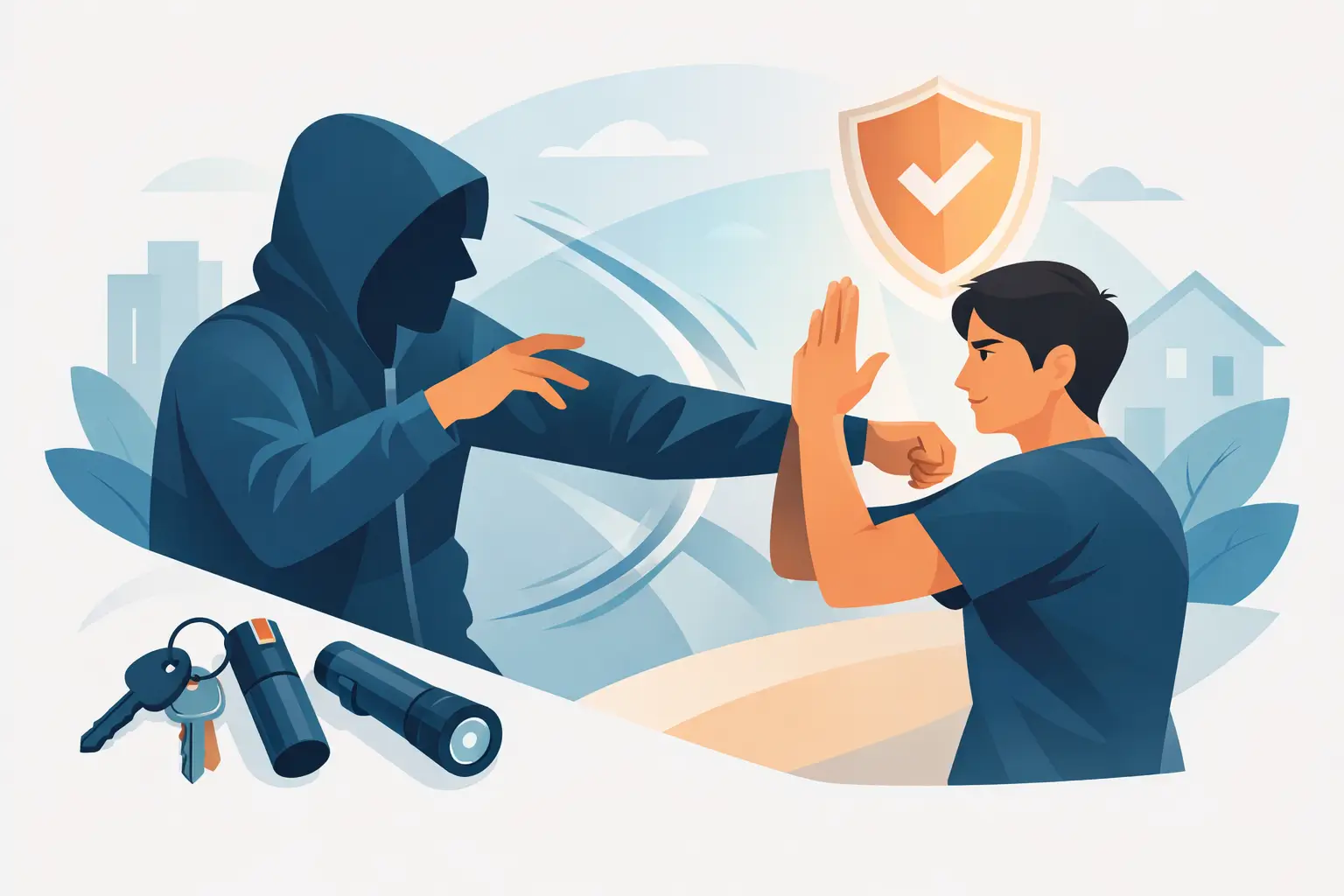
A confrontation rarely starts with a dramatic attack. More often, it begins with a stranger standing too close, an argument that will not settle, an uncomfortable walk home, or the feeling that something is not right. Effective self defence starts well before physical contact. It gives you the awareness, confidence and practical skills to make better decisions under pressure.
For teenagers and adults, that confidence can carry into every part of life. You stand a little taller, set clearer boundaries and feel less likely to freeze when someone tries to intimidate you. The aim is not to look for trouble or prove you are tough. It is to stay safe, protect yourself where necessary and get home.
What Realistic Self Defence Means
There is a big difference between martial arts training designed for points, performance or tradition, and training designed around real-life personal safety. Both can have value, but they prepare you for different situations.
Practical self defence considers the kind of pressure people actually face: close distances, limited space, surprise, awkward clothing, uneven ground and a fast rise in adrenaline. There may be no time for a perfect stance or a complicated sequence. A useful response must be simple enough to recall when your heart is racing.
That does not mean training should be reckless. Good instruction is controlled, progressive and built around safety. Students learn how to move, cover up, create space and respond with purpose without being thrown into situations they are not ready for. Repetition matters because confidence is built through experience, not just explanation.
At Fusion Kung Fu, Shiyong Kung Fu is taught with this practical focus in mind. It draws on close-range Wing Chun foundations alongside useful ideas from other martial arts, without asking students to learn techniques simply because they look impressive.
Self Defence Begins With Avoidance
The strongest outcome is always avoiding physical violence altogether. This is not weakness. It is sound judgement.
Awareness is one of the first skills worth developing. That can mean noticing who is around you, recognising when somebody’s behaviour is becoming more aggressive, keeping your phone away when walking alone, and trusting the feeling that tells you to leave. It also means understanding that pride can turn a manageable disagreement into a dangerous situation.
Verbal boundaries matter too. A firm, clear voice can create attention, communicate that behaviour is not acceptable and give you a moment to move away. For younger students, this is especially valuable in bullying situations. Assertiveness is not about shouting the loudest. It is about staying composed, being direct and knowing when to involve a parent, teacher or another responsible adult.
There are situations where walking away is easy, and others where it is not. Perhaps someone has blocked your path, grabbed hold of you, or followed you. That is why awareness alone is not enough. Physical training gives you options when avoidance has failed.
Why Simple Skills Are More Reliable Under Pressure
When people are frightened, the body changes quickly. Breathing gets shorter, fine motor control drops and clear thinking becomes harder. This is why highly complex moves are a poor foundation for personal protection.
Training should focus on direct, repeatable actions. Students need to understand balance, posture, distance and how to protect their head while moving. They need to practise escaping common grips, dealing with pressure at close range and making enough space to leave safely.
Power is useful, but technique, positioning and timing are often more important. A smaller person cannot rely on being stronger than an aggressor. They can, however, learn to use their body efficiently, target openings, disrupt balance and avoid being held in one place. This makes practical training suitable for people of different sizes, ages and fitness levels.
The goal is never to win a fight for the sake of it. The goal is to break contact, create a route away and seek safety. That distinction keeps self defence grounded in common sense.
Calm Is a Skill You Can Train
Confidence is sometimes misunderstood as having no fear. In reality, confident people still feel nervous. The difference is that they have practised responding sensibly despite that feeling.
Structured martial arts classes help develop this calm gradually. You work with partners, follow clear drills and become familiar with controlled pressure. Over time, being close to another person, making contact and responding quickly feels less overwhelming.
For a teenager who worries about bullying or social pressure, that can be a major change. For an adult managing stress from work, family life or past experiences, training can offer a focused hour where progress is clear and measurable. You do not need to be naturally sporty. You need a willingness to turn up, listen and improve one step at a time.
The Personal Benefits Reach Beyond Safety
Self defence training is often chosen because somebody wants to feel safer. That is a strong reason to start, but the benefits rarely stop there.
Regular training develops fitness in a functional way. You improve coordination, mobility, stamina and strength while learning skills with a clear purpose. Unlike exercise that can become repetitive, martial arts gives you practical challenges to work through, which helps many students stay consistent.
Discipline develops through routine. You learn to arrive on time, practise details, accept correction and keep going when something does not come easily. These habits can support school, work and home life just as much as training.
There is also the value of community. A good club should feel welcoming to beginners while maintaining high standards. Students train alongside people who are there for similar reasons: to get fitter, learn a useful skill, build confidence and challenge themselves in a respectful environment. Nobody needs to arrive already flexible, fearless or experienced.
A Sensible Approach for Teenagers and Adults
Teenagers aged 13 and over can benefit from learning how to spot risk, manage confrontation and carry themselves with more confidence. They also need the maturity to understand that self defence is not a licence to retaliate. The best response to bullying or harassment will depend on what is happening, where it is happening and whether there is a safe adult who can intervene.
Adults may have different concerns. Some want greater confidence when travelling, working late or exercising outdoors. Others want a practical alternative to the gym, or they may be returning to exercise after years away. The right class meets people where they are and builds from there.
Progress should be earned, not rushed. Beginners benefit from learning fundamentals properly before moving into more demanding drills. More experienced students benefit from refining their timing, awareness and decision-making rather than collecting endless techniques. This creates training that is challenging without becoming intimidating.
Train With Responsibility, Not Ego
Physical self defence carries responsibility. In the UK, any force used in protection of yourself or another person must be reasonable in the circumstances as you honestly believed them to be. That is another reason practical training should teach awareness, restraint and escape alongside physical skills.
A capable martial artist does not need to advertise it. They are less likely to be drawn into pointless arguments because they understand the potential consequences of violence. They know that even a single punch can cause serious harm, and that the safest outcome is often the one where everyone gets away.
This mindset is not passive. It is prepared. It means recognising danger early, acting decisively when required and making sensible choices afterwards, including seeking help and reporting an incident.
Start Where You Are
You do not need to wait until you feel fit enough, confident enough or young enough to begin. Those qualities are often the result of training, not the entry requirement. A well-run beginner class gives you the space to learn at your own pace, ask questions and build capability without pressure to perform.
The most useful self defence skill is the one you can remember and apply when it counts. Start by learning in a safe environment, train consistently and let each session make you a little more aware, capable and assured.
About the Author: Keith Ratcliffe
